





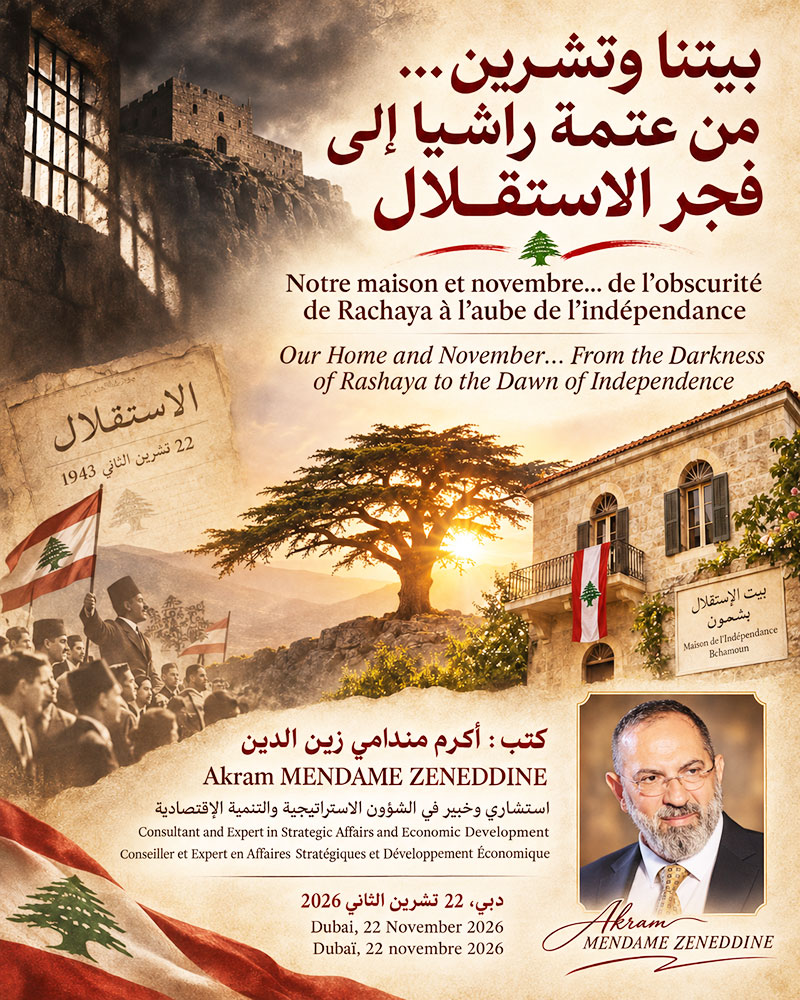
كتب: أكرم مندامي زين الدين *
في بيتنا، لم يكن الثاني والعشرون من تشرين الثاني يومًا عاديًا، ولا مجرد عيد وطني تعود فيه الأعلام إلى الشرفات وتستعيد المدارس أناشيد الاستقلال. ففي هذا اليوم وُلد والدي حسيب زين الدين، ثم شاءت الأقدار أن يعود التاريخ نفسه مع أربعة من أحفاده، خالد ابني، ورمزي، وأمير، وريان، ليصبح يوم الاستقلال موعدًا عائليًا يتكرر عبر الأجيال. خمسة مواليد جمعهم يوم واحد، وإن اختلفت سنوات ميلادهم، وكأن الذاكرة أرادت أن تمنح هذا التاريخ مكانًا خاصًا في بيتنا، إلى جانب مكانته في تاريخ الوطن. لم أكن بحاجة إلى أن أصنع من هذه المصادفة بطولة عائلية، ولا أن أحمّلها أكثر مما تحتمل؛ لكنها كانت كافية لتجعلني، كلما اقترب عيد الاستقلال، أعود إلى سؤال لم يفارقني: ماذا نعرف حقًا عن الأيام التي صنعت الثاني والعشرين من تشرين الثاني، وعن الرجال والنساء والأطفال الذين عاشوا أحداثها، ودفع بعضهم حياته ثمنًا لها؟
كنت كلما قرأت عن استقلال لبنان أجد الرواية تبدأ غالبًا باعتقال الرئيس بشارة الخوري ورفاقه، وتنتهي بالإفراج عنهم، كأن الأيام الفاصلة لم تكن سوى أزمة سياسية حُلّت بتدخل خارجي. لكنني حين دخلت إلى المذكرات والشهادات والبرقيات الدبلوماسية، اكتشفت أن لبنان عاش في تلك الأيام حكاية أوسع بكثير من سجن رئيس وعودته إلى الحكم. كانت بيروت تنتفض، وطرابلس تودّع أبناءها، وصيدا تقاوم، وبشامون تحتضن حكومة ترفض الاستسلام، فيما كانت قلعة راشيا تحبس رجال الدولة، ولم يكن السجّان يدرك أن الأبواب التي أغلقها على أجسادهم لم تستطع أن تغلق ضمائرهم على إرادة الحرية، وأن أرضًا تمرّست على الصبر تعرف كيف تنتظر ساعة الخلاص. وفي الجزائر والقاهرة ولندن وواشنطن، كان آخرون يتداولون مصير بلد لم يعد يريد أن يكون موضوعًا لقراراتهم. وبين هذه الأمكنة كلها كانت تتشكل حكاية الاستقلال؛ حكاية شعب لم ينتظر أن تنتهي المفاوضات كي يعلن موقفه، ودولة كانت تحاول أن تثبت أنها موجودة حتى حين اعتُقل من يتولون قيادتها.
ولم تبدأ هذه الحكاية سنة 1943. فمنذ نهاية الحرب العالمية الأولى، حمل اللبنانيون مطالبهم إلى مؤتمر الصلح في باريس سنة 1919، في وفود تعاقبت، من الوفد الذي ترأسه داود عمّون إلى وفد البطريرك الماروني إلياس الحويك، قبل أن تقرر القوى المنتصرة في مؤتمر سان ريمو سنة 1920 وضع لبنان وسوريا تحت الانتداب الفرنسي. وفي الأول من أيلول من السنة نفسها، أعلن الجنرال هنري غورو قيام دولة لبنان الكبير من قصر الصنوبر في بيروت، لكن ولادة الكيان لم تكن مرادفة لامتلاك قراره. ثم وُضع الدستور سنة 1926، واحتفظ المفوض السامي الفرنسي بصلاحيات تسمح له بتعليقه وحل المجلس النيابي، فيما تداخلت المطالب الدستورية مع الاحتجاجات الاقتصادية ومع الثورة السورية الكبرى التي امتدت مواجهاتها سنة 1925 إلى مناطق لبنانية. وحين سقطت فرنسا أمام ألمانيا سنة 1940، ودخلت القوات البريطانية وقوات فرنسا الحرة إلى سوريا ولبنان في حزيران 1941، تكررت وعود الاستقلال، حتى أعلنه الجنرال جورج كاترو في تشرين الثاني من السنة نفسها، من دون أن ينهي صلاحيات الانتداب. وهنا بدأ اللبنانيون يدركون أن الفرق كبير بين استقلال يُعلَن باسمهم واستقلال يمارسونه بإرادتهم.
وفي سنة 1943، جاءت الانتخابات النيابية لتفتح الباب أمام مرحلة مختلفة. انتُخب بشارة الخوري رئيسًا للجمهورية في الحادي والعشرين من أيلول، ثم شكّل رياض الصلح حكومته، في ظل تفاهم سياسي بين قوى لبنانية مختلفة أرادت أن تجعل الاستقلال أولوية مشتركة. لم تختفِ الخلافات حول هوية لبنان وعلاقاته العربية والغربية، ولم يتحول المتنافسون إلى أصحاب رأي واحد، لكنهم استطاعوا الالتقاء عند قضية أساسية: لا معنى لدستور لا يستطيع اللبنانيون تعديله، ولا لاستقلال تبقى معه السلطة الأجنبية قادرة على إلغاء قرارات المؤسسات المنتخبة. وفي السابع من تشرين الأول، أعلن رياض الصلح في البيان الوزاري التزام الحكومة بالاستقلال التام ورفض الحماية الأجنبية وتعديل الدستور بما ينسجم مع سيادة البلاد. كان الكلام واضحًا، لكن الاختبار الحقيقي لم يتأخر.
في الثامن من تشرين الثاني، أقرّ مجلس النواب التعديلات الدستورية التي أزالت الأحكام المرتبطة بالانتداب وأكدت استقلال السلطة اللبنانية. وفي اليوم التالي، وقّع الرئيس بشارة الخوري التعديلات. لم يكن الخلاف على مواد قانونية مجردة، بل على السؤال الذي سيحدد مستقبل البلاد: هل يملك اللبنانيون حق تقرير شؤون دولتهم، أم أن هذا الحق يبقى خاضعًا لموافقة المندوب الفرنسي؟ اعتبرت السلطة الفرنسية الخطوة تجاوزًا لصلاحياتها، وكانت قد أبلغت المسؤولين اللبنانيين اعتراضها على التعديل المنفرد. وهكذا دخل لبنان أيامًا لم يكن أحد يعرف كيف ستنتهي. وجاء الرد الفرنسي في الحادي عشر من تشرين الثاني، يوم الذكرى السنوية لهدنة الحرب العالمية الأولى، فحمل التوقيت مفارقة قاسية: فرنسا التي عانت احتلال أرضها في الحرب الدائرة اعتقلت، في ذلك اليوم بالذات، رجالًا يطالبون بحرية بلادهم.
فجر الحادي عشر من تشرين الثاني… حين دخل الجنود إلى بيت الرئيس
كانت الساعة تقترب من الثالثة بعد منتصف الليل حين استيقظ بشارة الخوري وزوجته على ضجة في المنزل. لم يفهم في البداية مصدر الأصوات، ففتح باب غرفته ليرى ما يجري، فإذا بجنود فرنسيين مسلحين يقفون أمامه، وإلى جانبهم جنود آخرون يحملون بنادق تعلوها الحراب. في اللحظات الأولى، خشي أن يكون الأمر محاولة اغتيال. أغلق الباب، وحاول أن ينادي من النافذة، لكن البيت كان مطوقًا والصمت يخيّم على الخارج. ثم دخل ابنه ميشال برفقة ضابط فرنسي أبلغه أن لديه أمرًا باعتقال رئيس الجمهورية.
لم يكن بشارة الخوري رجلًا يجهل طبيعة الخلاف مع المندوب العام الفرنسي جان هلّلو، لكنه لم يكن يتوقع أن ينتهي الخلاف الدستوري باقتحام منزله ليلًا. اعترض على شرعية الأمر، متمسكًا بصفته رئيسًا لجمهورية مستقلة، لكن الضابط لم يكن يحمل تفويضًا للنقاش. كانت لديه تعليمات بالتنفيذ، ومهلة قصيرة يمنحها للرئيس لارتداء ثيابه والخروج.
اقتيد الخوري من منزله إلى سيارة كانت تنتظر من دون أنوار، ورافقه رجال مسلحون. كانت شوارع بيروت شبه خالية، والسيارة تصعد باتجاه عاليه وبحمدون، فيما البرد يشتد والفجر يقترب. وعلى الطريق، لاحظ سيارة أخرى تتقدم موكبه وتتبادل معه إشارات بالأضواء. ولمّا اقتربت السيارتان من شتورا وراشيا، استطاع أن يميز في المقعد الخلفي للسيارة الأولى طربوشًا يعرفه جيدًا؛ كان طربوش رياض الصلح. عندها أدرك أن الاعتقال لم يستهدفه وحده، بل طال رئيس حكومته أيضًا.
وعند السادسة صباحًا، وصلت السيارات إلى قلعة راشيا. دخل بشارة الخوري ورياض الصلح، ثم تبعهما سليم تقلا وكميل شمعون، ثم لحق بهم عبد الحميد كرامي وعادل عسيران. أصبح رئيس الجمهورية ورئيس حكومته ووزراء ونائب معتقلين داخل قلعة بعيدة عن العاصمة، بينما كان الفرنسيون يستعدون لإبلاغ البلاد بأن نظام الحكم الذي انتخبته مؤسساته قد عُطّل بقرار من سلطة الانتداب.
أُدخل الخوري أولًا إلى غرفة لا تكاد تحتوي إلا كرسيًا خشبيًا، ثم نُقل إلى غرفة أخرى أكثر ملاءمة. وفي ساعات الاعتقال الأولى، جاء جنود لبنانيون يخدمون في القلعة ليعبّروا له عن احترامهم وأسفهم لما جرى. لكن المسؤول الفرنسي لاحظ ذلك، فأبعدهم عن حراسته، ووضع على باب غرفته جنديًا آخر. كان هذا المشهد، كما رواه الخوري في مذكراته «حقائق لبنانية»، يكشف أن سلطة الاعتقال تستطيع تغيير الحراس، لكنها لا تستطيع أن تتحكم بما يشعر به كل جندي تجاه رئيس بلاده.
وفي تلك القلعة، لم تكن اللحظات كلها متشابهة. كان المعتقلون يحاولون تبادل الكلمات كلما سنحت الفرصة، والحراس يراقبون اتصالاتهم ويمنعون اجتماعهم. وفي إحدى المرات، التقى بشارة الخوري رياض الصلح قرب الحمام، فتبادلا حديثًا قصيرًا عن معنى الاعتقال وما يمكن أن يتركه في نفوس اللبنانيين. وبعد أن لاحظ الحراس اللقاء، اتُّخذت إجراءات حالت دون تكراره. حتى الكلمات القليلة أصبحت أمرًا تخشاه سلطة أرادت عزل رجال الدولة بعضهم عن بعض.
لكن أكثر ما استوقفني في رواية الخوري كان موقف أحد الضباط الفرنسيين المكلفين إدارة شؤون القلعة. فقد زاره وأبدى خجله مما حدث، وحرص على أن يعامله باحترام، ثم غلبه التأثر حتى ظهرت الدموع في عينيه. وجد الرئيس المعتقل نفسه، في مفارقة إنسانية مؤثرة، يخفف عن ضابط ينتمي إلى السلطة التي سجنته. وهذه التفصيلة وحدها تكفي لتذكرنا بأن قرارات الدول لا تمحو ضمائر الأفراد، وأن الفرنسي الذي يصدر أمر الاعتقال ليس بالضرورة شبيهًا بالجندي الذي يشعر بالخجل وهو ينفذه.
ومع مرور الأيام، بدأ المعتقلون يشعرون بثقل العزلة. كانت الأخبار تصل بصعوبة، أحيانًا من أحاديث الحراس، وأحيانًا عبر أوراق صغيرة، وأحيانًا مما يستطيع رياض الصلح جمعه من معلومات. ويروي بشارة الخوري أن رئيس حكومته أقام ما يشبه مكتبًا للأخبار داخل المعتقل، وتمكن من إيصال معلومات عن احتجاجات بيروت وتشكيل حكومة في بشامون. كان الهدف الفرنسي فصل رجال الدولة عن البلاد، لكن البلاد كانت تجد طريقها إليهم حتى من وراء أبواب القلعة.
بيروت… حين لم يعد الصمت ممكنًا
في بيروت، لم يبقَ خبر الاعتقال حبيس المكاتب الرسمية. انتشر منذ الصباح، وخرج الناس إلى الشوارع، وأُقفلت المتاجر، واندفعت الجموع نحو الساحات ومحيط القصر الرئاسي. تحولت الطرقات إلى أماكن احتجاج، ووقعت مواجهات مع القوات الفرنسية، وتحدثت شهادات عن انقلاب عربات عسكرية وإحراق بعضها وإطلاق النار على متظاهرين.
كانت زوجة بشارة الخوري لا تزال في منزل العائلة، تستقبل الوفود والمتظاهرين الذين قصدوا المكان تعبيرًا عن رفضهم الاعتقالات. ويروي الخوري أن إطلاق النار أصاب محيط المنزل، وأن جرحى أُسعفوا داخله، وبقيت آثار دمائهم على بساط المدخل حتى عودته من راشيا. لم يكن قد شاهد ذلك بنفسه أثناء وقوعه، لكنه عرفه لاحقًا، واحتفظ به في مذكراته بوصفه جزءًا من الأيام التي غاب فيها عن بيته وعن الحكم.
وفي الشوارع، لم يكن الغضب محصورًا بأنصار الرئيس أو رئيس الحكومة. كانت فئات اجتماعية وسياسية مختلفة ترى في الاعتقال إهانة لمؤسسات الدولة، حتى إن الخلافات التي فرقت اللبنانيين في قضايا كثيرة بدت، في تلك اللحظة، أصغر من أن تحجب خطورة ما حدث. وتحتفظ روايات لاحقة بذكر ضحايا من عائلتي عيتاني ومخزومي في احتجاجات العاصمة. وقد بقيت بعض تفاصيل هذه الشهادات وأسماء أصحابها بحاجة إلى تحقيق تاريخي أوسع، لكنها تذكّر بأن العاصمة لم تعش تلك الأيام من دون خسائر بشرية.
وفي مجلس النواب، كان رجال السياسة الذين أفلتوا من الاعتقال يبحثون عن وسيلة لإعلان أن الدستور لم يسقط لمجرد أن المندوب الفرنسي قرر تعطيله. وتمكن عدد محدود من النواب من الاجتماع في ظل الإجراءات العسكرية، وارتبطت تلك الأيام بمشهد العلم اللبناني الجديد، بخطّيه الأحمرين ومساحته البيضاء وأرزته الخضراء. وتعددت الروايات بشأن تفاصيل رسمه والأيدي التي شاركت في ذلك، لكن المعنى الذي حمله كان واضحًا: أراد اللبنانيون علمًا يعبّر عن دولتهم وحدها، لا عن استمرار الوصاية عليها.
وكانت الصحافة تخوض معركتها الخاصة. توقفت صحف أو مُنع صدورها، وظهرت نشرات سرية تنقل أخبار الاعتصامات والمواجهات ومواقف الحكومة. ومن بينها نشرة «علامة الاستفهام»، التي يروي زهير عسيران أنه أصدرها مع نعيم مغبغب وبعض رفاقهما، وأنهم نقلوا طباعتها إلى صيدا، إلى مطبعة العرفان، بعيدًا عن رقابة السلطات الفرنسية، بعدما توعدت هذه السلطات بإعدام كل صاحب مطبعة يطبعها. كانت الورقة المطبوعة يومها وسيلة مقاومة، لا لأنها تحمل سلاحًا، بل لأنها تمنع احتكار الخبر في زمن كانت السلطة العسكرية تريد أن تقرر ما يجوز للناس أن يعرفوه.
ومن بيروت، امتدت أصوات الاحتجاج إلى المدن الأخرى، وفي مقدمتها طرابلس.
طرابلس… حين صار الطريق إلى الاستقلال طريقًا إلى المقبرة
كان اعتقال عبد الحميد كرامي قد ترك أثرًا عميقًا في طرابلس. فقد كان من الشخصيات التي ارتبطت بالحياة السياسية والشعبية للمدينة، وجاء اقتياده إلى راشيا ليضيف إلى الغضب الوطني شعورًا محليًا مباشرًا بالإهانة. وفي الثاني عشر من تشرين الثاني، خرجت الاحتجاجات بعد صلاة الجمعة، وتجمعت الجموع في محيط الجامع المنصوري الكبير واتجهت نحو شوارع المدينة وساحاتها.
وفي اليوم التالي، السبت الثالث عشر من تشرين الثاني، تجددت التظاهرات. خرج تلاميذ من مدارسهم، والتحق بهم طلاب أكبر سنًا ومواطنون، وتقدمت المسيرة في شوارع طرابلس، حاملة مطلب الاستقلال والإفراج عن المعتقلين. لم يكن الذين خرجوا يعرفون أن ذلك الصباح سيدخل ذاكرة مدينتهم بوصفه واحدًا من أكثر أيامها إيلامًا.
ومن بين شهود تلك الساعات كان الشاب جورج خضر، الذي أصبح لاحقًا مطرانًا للروم الأرثوذكس. كان يومها طالبًا في كلية الحقوق بالجامعة اليسوعية، وقد جاء إلى طرابلس خلال عطلة ذكرى الهدنة. ويروي أنه كان جالسًا في أحد مقاهي ساحة التل حين مرت تظاهرة آتية من المدينة القديمة ومتجهة نحو الميناء، فوجد نفسه يسير معها إلى جانب طلاب آخرين عادوا من بيروت. كانت المسيرة، بحسب شهادته، سلمية، وكان المشاركون يسيرون بترتيب تتقدم فيه الفئات العمرية الصغيرة.
ثم ظهرت أمامهم دبابة فرنسية يقودها جندي سنغالي. يقول خضر إن الجندي حاول أن يحيد عن التظاهرة، لكن ضابطًا فرنسيًا أمره بالتقدم وإطلاق النار. بدأت الدبابة تطلق الرصاص، واحتمى بعض الناس خلف الأبنية، غير أن المواجهة لم تتوقف عند ذلك. فقد دهست الدبابة متظاهرين، وكان الأطفال الذين تقدموا المسيرة أول من تعرض للخطر. ولم يكن الجندي الذي حاول أن يحيد عن الأطفال إلا ابن شعب آخر يرزح تحت الاستعمار، أُرسل ليقمع شعبًا يطلب استقلاله، فيما بقي القرار في يد الضابط الذي أصدر الأمر.
لم يكن جورج خضر يروي حادثة سمع عنها بعد سنوات، بل مشهدًا بقي حاضرًا في ذاكرته. وقد تحدث عن سقوط أحد عشر تلميذًا، وعن وصول سيارة تابعة للجيش البريطاني جُمعت فيها الجثامين وسط الفوضى والصدمة. أما روايات محلية أخرى، فحفظت قائمة بأربعة عشر اسمًا من الأطفال والفتيان الذين نسبت استشهادهم إلى أحداث ذلك اليوم: سليم صابونة، وأحمد صابر كلثوم، ورشيد رمزي حجازي، وفوزي قاسم شحود، ومحمد ثروت، وعبد الغني أفيوني، وعباس إبراهيم حبوشي، ومحمد علي حسين خضر، وعبد القادر مصطفى الشهال، وكمال عبد الرزاق ضناوي، ووديع خاطر بركات، وأحمد جوجو، ومحمد حسين المحمد، وسليم الشامي.
ولا تتطابق الحصائل التي حفظتها الروايات المحلية مع الأرقام البريطانية المعاصرة؛ فقد قدّر ريتشارد كيسي، وزير الدولة البريطاني المقيم في القاهرة، في منتصف الشهر، عدد الإصابات في لبنان كله بنحو مئة وأربعين، بينها عشرة قتلى أو اثنا عشر، وهو رقم يقل عن قائمة طرابلس وحدها. أما برقية الوفد الفرنسي في بيروت عن ذلك اليوم، فقالت إن الوضع هادئ عمومًا، وإن طرابلس لم تشهد حوادث مهمة. لذلك تبقى القائمة شهادة على ما حفظته ذاكرة طرابلس، لا بديلًا عن التدقيق في سجلات الضحايا. أما وقوع المواجهة وسقوط قتلى وجرحى خلالها، وبينهم تلاميذ، فتؤيده شهادات متعددة.
وأحاول، كلما عدت إلى هذه الروايات، أن أستعيد المسافة القصيرة التي فصلت أولئك التلاميذ بين مقاعد الدراسة وطريق التظاهرة. لم يكونوا يعرفون شيئًا عن المداولات التي تجري في الجزائر، ولا عن الرسائل التي ستغادر واشنطن إلى الدبلوماسيين الفرنسيين، ولا عن الإنذار الذي ستوجهه بريطانيا بعد أيام. كانوا أبناء مدينة تشعر بأن رئيس الجمهورية ورئيس حكومته وواحدًا من أبرز رجالها قد أُخذوا إلى المعتقل، وأن الاعتراض على ذلك أصبح واجبًا وطنيًا. ثم انتهت المسيرة، بالنسبة إلى بعضهم، قبل أن ينتهي الطريق.
وشيّعت طرابلس ضحاياها إلى مقبرة باب الرمل، بينما كانت المعركة السياسية مستمرة. وفي الوقت الذي كانت فيه بيروت تنتظر أخبار راشيا، كانت طرابلس قد دفعت ثمنًا لا تستطيع برقية دبلوماسية أن تختصره. واليوم تحمل لوحة وضعتها بلدية طرابلس عند مدخل مقبرة الشهداء أسماءهم، ويوضع أمامها إكليل في كل عيد استقلال منذ سنة 2010، فيما تحدثت الصحافة عن قبور أُهملت وشواهد تهدّمت. وفي العشرين من تشرين الثاني 2025، دعا رئيس الجمهورية العماد جوزاف عون، في مستهل جلسة لمجلس الوزراء، إلى تكريم هؤلاء الأطفال وحفظ ذكراهم، أسوة برجالات الاستقلال.
صيدا… مدينة تقاوم ولا تنتظر أن تُروى حكايتها من بيروت
لم تكن صيدا خارج تلك الأيام. فقد خرج أهلها في تظاهرات متواصلة، وواجهوا سلطات الانتداب، وسقط فيها قتلى وجرحى. وينقل الطبيب والسياسي نزيه البزري، الذي عايش الأحداث، صورة مدينة لم تهدأ بعد يوم واحد من الاحتجاج. فقد تحدث عن مواجهات استمرت أيامًا، وعن جرحى نُقلوا إلى مستشفى الخليل، وعن محاولات فرنسية لمنع إقامة تشييع واسع لبعض الضحايا.
ومن بين الأسماء التي وردت في شهادته حكمت صباغ، التي عُرفت لاحقًا باسم يمنى العيد، وكانت يومها تلميذة لم تتجاوز الثامنة. وقد تحدث عن إصابتها في ساقها، وعن طبيب إنكليزي أراد أن يبترها، قبل أن تُعالج من دون بتر. وروت هي في سيرتها «أرق الروح» أنها تسللت إلى التظاهرة من دون علم أهلها، ورأت زميلتيها ثروت وشفيقة تنزفان حتى فارقتا الحياة. كما ذكر البزري أن أحد الذين سقطوا كان من عائلته. وتحفظ روايات صيداوية أسماء ثلاثة من شهداء تظاهرة الخامس عشر من تشرين الثاني، كبرى تظاهرات المدينة: الطالبة ثروت صباغ، في العاشرة، والطالبة شفيقة أرقدان، في الثامنة، والطالب سعيد البزري، في السادسة عشرة. هذه شهادات مهمة لأنها تمنح صيدا صوتًا من داخلها، بدل أن نكتفي بذكرها في سطر واحد بين المدن التي شهدت احتجاجات.
ولم تكن تظاهرات صيدا مجرد امتداد لما كان يحدث في العاصمة. كانت تعبيرًا عن مشاركة مدينة كاملة في معركة الاستقلال، وعن شعور بأن قضية المعتقلين والسلطة الشرعية ليست شأنًا بيروتيًا أو جبليًا، بل قضية وطن. وقد تحدث البزري عن استمرار الاحتجاجات في المدينة القديمة رغم القمع، وعن وصول أخبار حكومة بشامون إلى المقاومين في صيدا، قبل أن يتجه بعضهم إلى بيروت للمشاركة في احتفالات الإفراج.
وهكذا، بينما كانت طرابلس تنعى أبناءها، كانت صيدا تعالج جرحاها وتستمر في احتجاجاتها، وبيروت تحاول إبقاء مؤسسات الدولة حية، وكان على جبل قريب من العاصمة بيت يستعد لأن يصبح مقرًا لحكومة لا تعترف بشرعية القرارات الفرنسية.
بشامون… بيت الشيخ حسين الحلبي حين أصبح بيتًا للوطن
بعد الاعتقالات، لم يقبل وزير الدفاع الأمير مجيد أرسلان، ونائب رئيس مجلس الوزراء حبيب أبو شهلا، ورئيس مجلس النواب صبري حمادة، أن تكون شرعية الحكم قد انتهت بغياب المعتقلين. اجتمعوا مع شخصيات وفاعليات أخرى، ثم اتجهوا إلى بشامون، حيث استقبلهم الأهالي أولًا في منزل مختار البلدة، الشيخ ضاهر عيد. وكان لا بد من إيجاد مقر أكثر ملاءمة لحكومة مهددة بالاعتقال والهجوم.
عندها تقدم الشيخ حسين أسعد الحلبي، صاحب منزل قائم على إحدى تلال بشامون المطلة على بيروت، وعرض استضافة رجال الاستقلال. ولم يكن جاهلًا بخطورة قراره؛ فقد كانت القوات الفرنسية قادرة على مهاجمة المقر واعتقال من فيه. لكن الشيخ حسين رأى أن حماية الدولة التي يناضل أبناؤها لاستقلالها تستحق المخاطرة، وفتح منزله للحكومة.
كان البيت قد شُيّد في أواخر القرن التاسع عشر، وله جناحان، أحدهما للإقامة والآخر للاجتماعات والعمل، وساحة تظللها سنديانة كبيرة. ولم تكن الغرف التي استقبلت رجال الدولة مجهزة لتكون بديلًا عن القصر الجمهوري أو السرايا الحكومية، لكنها أصبحت مقرًا لحكومة تتمسك بشرعيتها في وجه سلطة مسلحة تريد إسقاطها.
ومن حول البيت، بدأ الأهالي والمتطوعون يؤمّنون الحماية والمؤن والاتصالات. وتشكّل الحرس الوطني بقيادة نعيم مغبغب، شريك عسيران في «علامة الاستفهام»، وشارك فيه شبان من المنطقة وخارجها، بينما تولى الأمير مجيد أرسلان مسؤولية تنظيم الدفاع. لم يكن جميع المشاركين عسكريين نظاميين، بل كان بينهم رجال رأوا أن حماية الحكومة أصبحت واجبًا يتجاوز الانتماءات المحلية والسياسية.
ولم تكن المقاومة مقتصرة على الذين حملوا السلاح. فقد كان بعضهم ينقل الأخبار، وبعضهم ينظم المراسلات، وبعضهم يؤمّن حاجات الإقامة والحراسة، فيما كان آخرون يجوبون الطرق بين بشامون وبيروت وصيدا. ويروي زهير عسيران حادثة تكاد تبدو خارجة من رواية، لكنه يقدمها بوصفها جزءًا من تجربته الشخصية؛ فقد احتاجت حكومة بشامون، بحسب روايته، إلى الختم الرسمي لإرسال مراسلاتها، فدخل في الصباح الباكر، متنكرًا بملابس عامل تنظيف، إلى مكتب إميل إده، الذي عيّنته سلطة الانتداب رئيسًا للدولة بعد الاعتقال، وأخذ ختم رئيس الجمهورية وعاد به إلى بشامون.
لم يكن الختم مجرد أداة تترك أثرًا على الورق. لقد كان، في تلك الظروف، تعبيرًا عن رغبة حكومة مطاردة في أن تواصل مخاطبة الخارج باسم الدولة اللبنانية، بينما كانت سلطة الانتداب تحاول أن تسلبها صفتها الرسمية.
وفي المؤسسة العسكرية أيضًا ظهرت مواقف لها دلالتها. فقد نقل عسيران أن السلطات الفرنسية أمرت المقدم جميل لحود بمهاجمة حكومة بشامون واحتلال البلدة، لكنه امتنع عن تنفيذ الأمر، وأعلن تأييده للحركة الاستقلالية، ورفع العلم اللبناني الجديد على مقر فوجه في عين الصحة بفالوغا، وهو موقف يقول عسيران إنه كاد يكلّفه حياته. كانت تلك معضلة عميقة: كيف يؤدي العسكري واجبه داخل مؤسسة لم تنتقل قيادتها بعد إلى الدولة المستقلة، حين يجد أن الأوامر التي تصله قد توجهه إلى مواجهة حكومته الوطنية؟ ولا ينبغي الخلط بين هذه الواقعة وبين ما تحتفل به فالوغا كل سنة، أي رفع ضباط لبنانيين، في مقدمتهم المقدم لحود، علمًا لبنانيًا مكان العلم الفرنسي على أرضها في 23 أيلول 1943؛ فتلك واقعة أخرى سبقت أزمة تشرين الثاني بسبعة أسابيع.
وفي بشامون، كانت المواجهة تقترب.
في مساء الخامس عشر من تشرين الثاني، تقدمت قوات فرنسية مسلحة نحو مقر الحكومة، فتصدى لها الحرس الوطني وأجبرها على التراجع. لكن الهجوم لم يكن الأخير. ففي صباح السادس عشر من تشرين الثاني، عادت القوات الفرنسية بمدرعات وقوة أكبر، ودارت مواجهة استمرت ساعات. ويذكر البلاغ العسكري الذي أصدره الأمير مجيد أرسلان أن الحرس الوطني صد الهجوم المتكرر حتى بعد الظهر، وأن القوات الفرنسية تكبدت خسائر بين جنودها.
لكن الحرس الوطني فقد أحد رجاله.
كان اسمه سعيد فخر الدين، من بلدة عين عنوب.
لم يكن رئيسًا ولا وزيرًا ولا صاحب موقع في المفاوضات، ولم يكن في مقدوره أن يغيّر وحده ميزان القوة بين دولة منتدبة وبلد يريد استقلاله. لكنه كان في ذلك الصباح بين الذين تصدوا للهجوم، فسقط خلال المعركة، وأصبح اسمه جزءًا من تاريخها.
وفي السابع عشر من تشرين الثاني، سجّل الأمير مجيد أرسلان استشهاده في البلاغ الحربي الأول. وبعد الاستقلال، صدر المرسوم الجمهوري رقم 9377، بتاريخ الثاني من تموز 1946، بمنحه ميدالية الجهاد الوطني بعد الوفاة، وفق النص المنقول عن المرسوم، تقديرًا لمشاركته في معركة الاستقلال.
وليست دلالة سيرة سعيد فخر الدين في أنه استشهد دفاعًا عن مقر الحكومة فحسب، بل في أن اسمه دخل الذاكرة الوطنية من باب معركة عسكرية محددة، بينما بقيت أسماء أخرى لضحايا الانتفاضة أقل حضورًا في الرواية العامة. فقد اعتادت بعض الكتابات وصفه بأنه «شهيد الاستقلال الوحيد»، وهي عبارة لا تستقيم إذا أُطلقت على جميع أحداث تشرين الثاني 1943، بعدما عرفنا ما وقع في طرابلس وما روته شهادات بيروت وصيدا. وقد يصح الوصف إذا كان المقصود الشهيد الذي سجله البلاغ العسكري في معركة بشامون تحديدًا، لكنه لا ينبغي أن يتحول إلى نفي لدماء سقطت في مدن أخرى.
لا يحتاج سعيد فخر الدين إلى أن ننفي سواه كي نعترف بتضحيته، ولا يحتاج شهداء طرابلس أو ضحايا بيروت وصيدا إلى أن نقلل من شأنه كي يأخذوا مكانهم في التاريخ. لقد اختلفت الأمكنة والظروف، لكن الناس خرجوا في أيام واحدة دفاعًا عن استقلال بلدهم.
وبقيت السنديانة العتيقة في عين عنوب، حيث سقط، شاهدًا على فصل من تلك الأيام، فيما كانت المعركة السياسية تتسع خارج الجبل وخارج لبنان نفسه.
في أميركا أيضًا… حين حمل المغتربون قضية الاستقلال إلى واشنطن
لم تكن معركة الاستقلال محصورة بين المدن اللبنانية وقلعة راشيا وبيت بشامون. فخارج البلاد، كان لبنانيون يعيشون في الولايات المتحدة يتابعون أخبار وطنهم، ويحاولون استخدام ما تتيحه لهم الحياة السياسية الأميركية للتأثير في موقف واشنطن.
في مدينة فول ريفر بولاية ماساتشوستس، كانت جمعية جبل لبنان، التي أسسها أميركيون من أصل لبناني سنة 1911، تنظر بقلق إلى اعتقال رجال الدولة ومحاولة تغيير نظام الحكم اللبناني. وفي الثامن عشر من تشرين الثاني 1943، حمل السناتور الأميركي ديفيد إغناتيوس والش إلى مجلس الشيوخ نداءً من الجمعية، برئاسة فارس ناصيف الابن، يناشد الرئيس الأميركي فرانكلين ديلانو روزفلت ووزير خارجيته كورديل هَل استخدام نفوذ الولايات المتحدة لحماية استقلال لبنان، مستندًا إلى ميثاق الأطلسي الذي أقرّ حق الشعوب في اختيار شكل حكمها، وفي استعادة حقوقها السيادية التي انتُزعت منها بالقوة. وأُدرج النداء في السجل الرسمي للمجلس، في الصفحة 9665، ثم أُحيل إلى لجنة العلاقات الخارجية.
وللمشهد دلالته: ففي الوقت الذي كان فيه أهل طرابلس يدفنون ضحاياهم، وكانت صيدا تعالج جرحاها، وكانت بشامون تحمي حكومة لبنان الحر، كان أبناء لبنان في أميركا يخاطبون مؤسسات الدولة التي يحملون جنسيتها دفاعًا عن وطنهم الأم. لم تكن المسافة الجغرافية قد قطعت صلتهم بالقضية، ولم يكونوا يملكون جيشًا ولا حكومة، لكنهم عرفوا كيف يجعلون رسالتهم جزءًا من سجل سياسي رسمي يستطيع التاريخ أن يعود إليه.
لكن الدقة تفرض علينا هنا تمييزًا أساسيًا: لم يكن تحرك المغتربين الذي ظهر في سجل الكونغرس يوم الثامن عشر من تشرين الثاني سببًا في الاحتجاج الرسمي الذي أصدرته واشنطن قبل ذلك، في الثاني عشر من الشهر نفسه. فقد كانت الدبلوماسية الأميركية قد بدأت تحركها، بينما كان المغتربون يواصلون الضغط عليها ومساندة القضية اللبنانية.
وهكذا اجتمع في تلك الأيام صوت اللبناني المقيم داخل وطنه وصوت اللبناني الذي حمل وطنه معه إلى المهجر. اختلفت الوسائل، من التظاهرات إلى الرسائل والبرقيات، لكن المطلب كان واحدًا: أن يكون للبنان الحق في حكم نفسه.
من واشنطن إلى الجزائر… حين أصبحت أزمة لبنان اختبارًا للحلفاء
في الجزائر، كانت اللجنة الفرنسية للتحرير الوطني تنظر إلى ما جرى في لبنان باعتباره تحديًا لسلطة فرنسا ومكانتها في المشرق. وكان الجنرال شارل ديغول يخوض، في ذلك الوقت، معركة سياسية وعسكرية لإعادة الاعتراف بفرنسا قوةً قادرة على استعادة دورها بعد الاحتلال الألماني. ولم تكن مسألة لبنان بالنسبة إلى القيادة الفرنسية مجرد خلاف دستوري؛ فقد كانت تتصل بمستقبل النفوذ الفرنسي في الشرق الأوسط وبالعلاقة المتوترة مع بريطانيا، التي خشي الفرنسيون أن تكون راغبة في الحلول محلهم.
أما في بيروت، فقد حاول المندوب العام جان هلّلو تبرير الاعتقالات أمام الدبلوماسيين الأجانب. وتظهر برقيات جورج وادزورث، ممثل الولايات المتحدة في بيروت، المنشورة في وثائق وزارة الخارجية الأميركية، أنه تابع الأزمة منذ ساعاتها الأولى، وسجّل ما قدمه هلّلو من تفسيرات عن الخلاف الدستوري وموقف اللجنة الفرنسية في الجزائر. وفي القاهرة، كانت الحكومة المصرية تعترض على الإجراءات الفرنسية، وانضم إلى الاحتجاج العراق والملك عبد العزيز آل سعود.
وفي الثاني عشر من تشرين الثاني، صدرت من واشنطن تعليمات دبلوماسية تحمل احتجاجًا شديد اللهجة على الإجراءات المتخذة ضد ممثلي الجمهورية اللبنانية المنتخبين. وقد حملت البرقية رقم 2139، باسم وزير الخارجية الأميركي كورديل هَل، وطالبت القيادة الفرنسية في الجزائر بإعادة الحكومة اللبنانية وتنفيذ التعهدات السابقة بالاستقلال. وكان في الموقف الأميركي تناقض أرادت واشنطن أن تضعه أمام الفرنسيين: كيف يمكن لفرنسا، التي تعاني بلادها الاحتلال، أن تتجاهل تطلع شعب آخر إلى الاستقلال؟
لكن الموقف البريطاني كان أشد تأثيرًا في تطور الأزمة. فقد كان إدوارد سبيرز، الممثل البريطاني في بيروت، يتابع التحركات اللبنانية والفرنسية، فيما كان ريتشارد كيسي يدير الاتصالات السياسية مع القيادة الفرنسية. لم تكن بريطانيا مجرد مراقب يتعاطف مع مطالب اللبنانيين؛ كانت لها مصالح عسكرية واستراتيجية في المشرق، وكانت تخشى أن يؤدي استمرار الأزمة إلى اضطرابات تهدد استقرار منطقة حيوية في زمن الحرب. ولهذا لا أرى في التدخل البريطاني عملًا منفصلًا عن الحسابات الدولية، وإن كان قد أسهم بصورة حاسمة في الضغط من أجل إطلاق المعتقلين وإعادة المؤسسات الدستورية.
وفي تلك الأثناء، وصل الجنرال جورج كاترو إلى لبنان، مكلفًا بالبحث عن مخرج لأزمة لم يعد جان هلّلو قادرًا على احتوائها. وكان عليه أن يتعامل مع واقع مختلف عما واجهته السلطة الفرنسية ليلة الحادي عشر من تشرين الثاني. فلم يعد الأمر يتعلق برئيس وحكومة محتجزين في قلعة راشيا، بل بمدن تنتفض، وحكومة تتمسك بشرعيتها في بشامون، وضغط عربي ودولي يتصاعد.
الثامن عشر من تشرين الثاني… رئيس معتقل أمام جنرال جاء ليفاوضه
كان بشارة الخوري في قلعة راشيا حين وصل إليه، في السابع عشر من تشرين الثاني، رسول يحمل طلبًا من كاترو للقائه. وافق الخوري، وحدد موعدًا في اليوم التالي، لكن ساعات الثامن عشر مضت من دون أن يُعقد الاجتماع في القلعة. ومع حلول المساء، دخل ضباط فرنسيون إلى غرفته وأبلغوه أن كاترو ينتظره في بيروت.
خرج الرئيس المعتقل تحت الحراسة، وركب سيارة أقلته من راشيا إلى العاصمة. كان الطريق الذي قطعه يوم اعتقاله يعود أمامه من الاتجاه المعاكس، لكن ذلك لم يكن طريق الإفراج. ظل تحت الحراسة، وظلت المسدسات في أيدي مرافقيه. وعندما وصل إلى بيروت، وجد الشوارع شبه خالية، والجنود الفرنسيين منتشرين في مواقعهم. اقتيد إلى منزل أُعد للقاء، وهناك استقبله كاترو.
لم يكن الرجلان يجلسان إلى طاولة تفاوض عادية. أحدهما رئيس جمهورية منتخب اقتيد من منزله إلى السجن، والآخر جنرال فرنسي جاء ليبحث عن تسوية تحفظ موقع فرنسا وتمنع الأزمة من الانفجار أكثر. وقد روى الخوري لاحقًا أن كاترو أعرب عن أسفه لما حدث، ثم انتقل إلى السؤال الذي اعتبره الفرنسيون أساس الأزمة: لماذا استعجل اللبنانيون تعديل الدستور من دون التفاهم مع فرنسا؟
دافع الخوري عن موقف حكومته، مؤكدًا أن تعديل الدستور من صلاحيات المؤسسات اللبنانية، وأن المطالبة بالاستقلال لا تعني استبدال الانتداب الفرنسي بنفوذ بريطاني. كان الخلاف على جوهر السيادة، لا على صيغة اعتذار يمكن أن يقدمه أحد الطرفين للآخر.
ثم انتقل كاترو، وفق رواية الخوري، إلى طرح تسوية تتضمن إقالة حكومة رياض الصلح وحل مجلس النواب. رفض الرئيس الطلبين، لأنه أدرك أن عودته منفردًا إلى الحكم، إذا اقترنت بالتخلي عن الحكومة والمجلس، قد تمنح الفرنسيين ما عجزوا عن تحقيقه بالاعتقال: إعادة تشكيل السلطة اللبنانية وفق إرادتهم. وحين حاول كاترو البحث عن صيغة أخرى تحفظ اعتبار فرنسا، لم يصل اللقاء إلى اتفاق نهائي.
استمر النقاش أكثر من ساعتين، ثم عاد بشارة الخوري إلى قلعة راشيا.
وأتوقف هنا أمام مفارقة لا تقل دلالة عن الاعتقال نفسه. لقد أخرج الفرنسيون رئيس الجمهورية من زنزانته ليفاوضوه على مستقبل حكومته، ثم أعادوه إليها حين رفض الشروط. كانوا قد اعتقلوه لأنهم لم يقبلوا استقلال قراره، ثم اكتشفوا أن السجن لم يجعله أكثر استعدادًا للتنازل عنه.
وفي اليوم التالي، التاسع عشر من تشرين الثاني، ازدادت الضغوط البريطانية. فعند السادسة والنصف مساءً، سلّم ريتشارد كيسي الجنرال كاترو مذكرة حملت تهديدًا بإعلان الأحكام العرفية البريطانية إذا لم تُعد الحكومة اللبنانية المنتخبة إلى الحكم ويُفرج عن المعتقلين. وحُدّد الموعد بالعاشرة من صباح الثاني والعشرين من تشرين الثاني، قبل أن يُمدد خلال المفاوضات إلى صباح الرابع والعشرين. ووصل التوتر إلى حد أن كاترو قال للممثل الأميركي إن القضية كلها ذكّرته بفاشودة، المواجهة الاستعمارية بين فرنسا وبريطانيا على أعالي النيل سنة 1898.
كان لبنان قد أصبح نقطة احتكاك بين حليفين يقاتلان معًا في الحرب العالمية الثانية. لكن ما أعطى هذا الاحتكاك معناه السياسي أن اللبنانيين، في الداخل، كانوا قد رفضوا التسليم بالأمر الواقع. فلو لم تكن هناك حكومة في بشامون، ومجلس يتمسك بشرعيته، وشوارع تحتج، لما كان للضغط الدولي المضمون نفسه.
وهكذا التقت الإرادة اللبنانية مع حسابات الدول الكبرى، من دون أن تتطابق معها.
ليلة الحادي والعشرين… وطن ينتظر خبرًا لم يكتمل بعد
اقتربت الأيام من نهايتها، لكن الأزمة لم تكن قد انتهت. في بيروت، كان الناس ينتظرون الإفراج عن المعتقلين، وفي راشيا كان الرجال الستة يراقبون تبدل سلوك الحراس ويسألون عن الأخبار التي تتسرب إلى القلعة. أما في الجزائر، فكانت القرارات الفرنسية تتأخر، وتتعدد الصيغ المقترحة للتسوية، ولا سيما بشأن عودة رياض الصلح وحكومته.
كانت هناك محاولة للفصل بين الإفراج عن الرئيس وإعادة الحكومة بكاملها إلى ممارسة صلاحياتها، لكن اللبنانيين لم يكونوا قد خاضوا تلك الأيام ليعود رئيس الجمهورية وحده، تاركًا وراءه الحكومة والمجلس اللذين حاولت فرنسا إبعادهما. ولم يكن البريطانيون والأميركيون يعتبرون مجرد فتح أبواب القلعة كافيًا لمعالجة الأزمة الدستورية.
وفي تلك الساعات، كانت الأنباء تتقدم على القرارات. فقبيل الثامنة من مساء الحادي والعشرين، أذاعت المحطات العربية أن الجزائر رضخت للإنذار البريطاني، فخرج كثيرون من أهل بيروت إلى الشوارع يحتفلون. ثم تبيّن من تفاصيل البث أن الرئيس وحده سيعود في البداية، فخفت الفرح، واستمر الإضراب العام والاحتجاج، كما سجّل وادزورث في برقيته إلى واشنطن. كان اللبنانيون ينتظرون، وكان الفرنسيون يحاولون الوصول إلى مخرج، فيما ظل احتمال التصعيد قائمًا.
وفي قلعة راشيا، كان فجر جديد يقترب.
الثاني والعشرون من تشرين الثاني… حين فُتحت أبواب القلعة
يروي بشارة الخوري أنه استيقظ باكرًا في صباح الاثنين، الثاني والعشرين من تشرين الثاني 1943، وخرج إلى باحة القلعة. شاهد أحد الضباط المكلفين بالحراسة يؤدي له تحية عسكرية لم يكن يؤديها في الأيام السابقة، فشعر بأن شيئًا قد تغير. لم يكن قد تسلم بعد قرار الإفراج، لكن طريقة التعامل معه حملت أول إشارة إلى أن ساعات الاعتقال توشك أن تنتهي.
اجتمع المعتقلون وتبادلوا الأخبار والتوقعات، ثم انتظروا السيارات التي ستنقلهم إلى بيروت. مضت الساعات ببطء، قبل أن تظهر السيارات الرسمية القادمة إلى القلعة. ووصل المندوب الفرنسي لدى الحكومة اللبنانية، يرافقه الضابط سليمان نوفل، وأُبلغ الرئيس ورفاقه رسميًا بإطلاق سراحهم.
بدأ الرجال يجمعون حاجاتهم القليلة ويستعدون للمغادرة. كانت الأيام التي أمضوها في القلعة قد أصبحت وراءهم، لكن أثرها لم يكن قد انتهى. خرجوا إلى الباحة حيث كانت السيارات تنتظر، وقد تولى أفراد من الدرك اللبناني قيادتها. وعندما تحرك الموكب، ارتفعت من الطابق العلوي للقلعة أصوات معتقلين آخرين ينشدون النشيد الوطني اللبناني، ويتبادلون التحيات مع الرجال المغادرين.
في رواية الخوري، كانت تلك من أشد اللحظات تأثيرًا. لم يكن الوداع مجرد خروج ستة رجال من السجن، بل مشهدًا اختلطت فيه أصوات النشيد بقرع الأبواب والنوافذ، فيما كانت القلعة التي استُخدمت لعزل رجال الدولة تشهد خروجهم منها، عائدين إلى دولتهم.
ثم انطلقت السيارات نحو راشيا.
وما إن ظهرت في ساحة البلدة حتى قرعت الأجراس وتعالت الهتافات، واندفع الأهالي لاستقبال المعتقلين. خرج الدروز والمسيحيون إلى الطريق، وارتفعت أصوات الفرح والتحية، حتى اضطر الموكب إلى التمهل وسط الجموع. كان الناس يريدون الاقتراب من الرجال الذين طال انتظارهم، بينما كان هؤلاء يستعجلون الوصول إلى بيروت.
ومن راشيا إلى شتورا، ثم عبر المريجات وضهر البيدر، كانت السيارات تسلك طريقًا أخذت القرى والبلدات على امتداده تتحول إلى محطات استقبال. كان القادمون من الاتجاه المعاكس يتوقفون لتحية الموكب، وتلتحق سيارات أخرى به، حتى لم تعد رحلة العودة تشبه موكب الاعتقال الصامت الذي صعد إلى القلعة قبل أحد عشر يومًا.
وعند الاقتراب من حمانا، يروي بشارة الخوري أنه أوقف السيارة ودعا رياض الصلح إلى مرافقته، ثم أنزل العلم القديم عن السيارة، قبل أن يواصلوا الطريق نحو بيروت. كان العلم اللبناني الجديد قد أصبح رمزًا للمرحلة التي خرجوا لاستكمالها، ولم يكن المشهد بحاجة إلى خطبة تشرح معناه.
وفي العاصمة، كانت أحداث أخرى تجري بالتزامن مع رحلة العودة. فقد احتشد آلاف المواطنين حول النواب الذين تمكنوا من الاجتماع، ورافقوهم إلى مبنى البرلمان، فيما وقف الجنود الفرنسيون جانبًا واستقبلهم الدرك اللبناني. وأخذ العلم الجديد يرتفع فوق مبانٍ رسمية، من مجلس النواب إلى مقار الحكم، بعد أن أصبح رمزًا للشرعية التي رفض اللبنانيون التخلي عنها. ولم تكن الجموع تنتظر الموكب وحده، بل كانت تستعيد، في الشوارع والمؤسسات، مظاهر الدولة التي حاولت قرارات الانتداب تعطيلها.
وعندما وصلت سيارات المعتقلين إلى بيروت، كانت الحشود قد ملأت الطرقات والساحات. دخل الموكب العاصمة، ومر بساحة الشهداء من أمام السرايا، ثم اتجه إلى منزل بشارة الخوري. وكانت الجموع قد احتشدت حتى أصبح الدخول إلى البيت صعبًا. وقف الناس على المقاعد والكراسي، وتعالت الهتافات والتصفيق، بينما كان أفراد العائلة ينتظرون في الداخل.
وهناك، بعد أحد عشر يومًا من القلق والأخبار المتقطعة، التقى الرئيس زوجته وأولاده وأقاربه. يروي أن الدموع غلبت الحاضرين، وأن زوجته تأثرت إلى حد كادت معه تفقد وعيها. أما هو، فكان يحاول أن يتمالك نفسه وسط ذلك اللقاء؛ فقد أدرك أن الفرح لا يعفيه من العودة إلى مسؤولياته، وأن ما بدأ ليلة الاعتقال لم ينتهِ تمامًا بمجرد عودته إلى منزله. وغادر رياض الصلح ليلتقي عائلته، بعدما رافق الخوري إلى بيته.
كان ذلك اليوم الذي دخل الذاكرة اللبنانية عيدًا للاستقلال.
لكن التاريخ، حين نقترب من وثائقه، يذكرنا بأن الفرح الشعبي سبق اكتمال التسوية السياسية. فقد عادت السلطة اللبنانية، وفشلت محاولة فرض قيادة بديلة على البلاد، لكن بعض المطالب الفرنسية المتعلقة بالتعديلات الدستورية ظلت موضع نزاع حتى بعد الإفراج، واستمرت المداولات بشأن إلغاء جميع الآثار القانونية للإجراءات التي اتخذها هلّلو. ولم تكن جميع المصالح والصلاحيات قد انتقلت إلى الدولة اللبنانية، كما أن القوات الفرنسية لم تكن قد غادرت البلاد.
لهذا لا أرى في الثاني والعشرين من تشرين الثاني يومًا انتهت فيه جميع مراحل الاستقلال، بل يومًا حاسمًا استعادت فيه الشرعية اللبنانية مكانها، وثبت فيه أن قرار البلاد لا يمكن أن يُصادر بمجرد اعتقال المسؤولين المنتخبين.
أما استكمال السيادة، فكان طريقًا آخر.
بعد الاستقلال… حين أصبح للدولة جيش يحمل علمها
في الأول من آب 1945، تسلّمت الدولة اللبنانية قيادة القوات العسكرية اللبنانية، في محطة أساسية من انتقال السلطة الفعلية إلى مؤسساتها. وفي عيد الاستقلال من السنة نفسها، شاهد اللبنانيون عرضًا عسكريًا للجيش اللبناني، كما وصفته صحيفة «النهار» في تغطيتها لذلك اليوم.
كانت بيروت قد ارتدت زينتها، وازدانت واجهات المباني بالأعلام والأنوار، واحتشد الناس على الأرصفة والشرفات والنوافذ. وفي الليل، سارت مجموعات الجيش بالمشاعل والموسيقى، وفي الصباح امتلأت ساحة الشهداء بالجماهير التي جاءت تشاهد قوات بلدها تعرض أمامها في عيد الاستقلال.
ومن بين الصور التي احتفظ بها وصف الصحيفة، آليات عسكرية حملت أسماء جبال لبنان وأنهاره: صنين، وجبل الشيخ، وجبل عامل، والأرز، والباروك، ونهر إبراهيم. لم تكن الأسماء مجرد زينة على العربات؛ لقد حملت خريطة البلاد إلى شوارع العاصمة، وكأن الجيش الجديد يقدم نفسه للناس من خلال جغرافيا الوطن الذي أصبح مكلفًا بالدفاع عنه.
وفي سنة 1946، اكتمل جلاء القوات الفرنسية عن لبنان. وهكذا امتد الطريق من تعديل الدستور واعتقال رجال الدولة سنة 1943، إلى انتقال القيادة العسكرية ثم خروج القوات الأجنبية. وكان الاستقلال الذي أعلن اللبنانيون انتصاره في الثاني والعشرين من تشرين الثاني قد احتاج إلى سنوات إضافية كي تستكمل الدولة بعض أهم مقومات سيادتها.
وحين أعود من هذا المشهد إلى سيرة والدي حسيب زين الدين، الذي خدم في الجيش اللبناني بعد الاستقلال، أجد أن الصلة بين تاريخ ميلاده وخدمته العسكرية لا تحتاج إلى مبالغة. إنها صلة إنسانية بسيطة بين رجل وُلد في اليوم الذي صار عيدًا للاستقلال، ومؤسسة نشأت في الدولة التي حمل ذلك اليوم اسمها. أما ما يزيد هذه المصادفة قربًا إلى قلبي، فهو أن التاريخ نفسه عاد مع أربعة من أحفاده، ليبقى الثاني والعشرون من تشرين الثاني حاضرًا في بيتنا عبر الأجيال.
حين تتسع ذاكرة الاستقلال لكل أبنائه
كلما عدت إلى أيام تشرين الثاني 1943، ازددت اقتناعًا بأن الاستقلال لم يكن حكاية رجل واحد، ولا مدينة واحدة، ولا مؤسسة واحدة. كان لبشارة الخوري ورياض الصلح دورهما في التمسك بشرعية الحكم، ولصبري حمادة والنواب موقفهم في الدفاع عن الدستور، وللأمير مجيد أرسلان وحبيب أبو شهلا مكانهما في استمرار الحكومة من بشامون، وللشيخ حسين أسعد الحلبي وأهالي البلدة فضل احتضانها، ولنعيم مغبغب ورفاقه ما قدموه من تنظيم وحماية واتصال، ولجميل لحود ومن اتخذوا مواقف مشابهة داخل المؤسسة العسكرية معنى خاص في تلك المواجهة.
وكان للصحافيين الذين تحدوا الرقابة، وللنساء اللواتي شاركن في الاحتجاج واستقبال الوفود، وللأطباء الذين عالجوا الجرحى، ولأهالي القرى الذين احتضنوا المقاومين أو استقبلوا المعتقلين في طريق عودتهم، نصيب من تلك الحكاية. وكذلك للمغتربين الذين حملوا قضية بلادهم إلى مؤسسات القرار في البلدان التي أقاموا فيها، ووجدوا في الرسائل والبرقيات وسيلة للدفاع عن حق وطنهم في الاستقلال.
لكن هناك أسماء أخرى لا ينبغي أن تختفي وراء أسماء المسؤولين. ففي طرابلس سقط تلاميذ ومتظاهرون، وفي صيدا سقط قتلى وجرحى، وفي بيروت دفعت الاحتجاجات ثمنًا بشريًا، وفي بشامون استشهد سعيد فخر الدين. وقد حفظت بعض المدن أسماء ضحاياها أكثر مما حفظتها الرواية الوطنية المشتركة، حتى أصبح اللبنانيون يعرفون أحيانًا شهداء منطقتهم ولا يعرفون شهداء المنطقة الأخرى.
ولا أرى أن إنصاف هؤلاء يبدأ بوضع كل الروايات في مرتبة واحدة، أو باختيار رقم نهائي للضحايا قبل مقابلة الوثائق، أو بتحويل مناسبة الاستقلال إلى منافسة بين المدن والأحزاب. إنما يبدأ بالاعتراف بأن التاريخ الوطني لا يكتمل إذا حصرناه في المراسيم والخطب وأسماء الذين جلسوا إلى طاولات التفاوض. فهناك من كان في الشارع، ومن كان في المدرسة قبل أن يخرج إلى التظاهرة، ومن حمل السلاح دفاعًا عن الحكومة، ومن أسعف جريحًا، ومن فقد أحد أفراد عائلته من دون أن يصبح اسمه جزءًا من الرواية التي تتكرر كل سنة.
وفي سيرة سعيد فخر الدين مثال على ذلك. فالرجل الذي سقط دفاعًا عن حكومة بشامون لا يحتاج إلى لقب يستبعد سواه كي نحفظ مكانته. وكذلك لا تحتاج طرابلس إلى أن تنازع بشامون على حقها في الذاكرة، ولا صيدا إلى أن تنازع بيروت. إن استقلال لبنان كان أكبر من جميع هذه الأمكنة، لكنه لم يكن ممكنًا من دون ما جرى فيها.
وأتساءل، بعد ثلاثة وثمانين عامًا، كيف يمكن لوطن أن يبني مستقبلًا مشتركًا إذا لم يتعلم أولًا كيف يروي ماضيه من دون إقصاء؟ وكيف نستطيع أن نطلب من الأجيال الجديدة الإيمان بالدولة إذا كانت ذاكرتها التاريخية نفسها لا تتسع لجميع الذين أسهموا في قيامها؟
ليس المطلوب أن نوزع الأوسمة بأثر رجعي على من نشاء، ولا أن نمنح التاريخ إجابات لم تقلها وثائقه. المطلوب أن نبحث، وأن نصغي إلى الشهادات، وأن نميّز ما ثبت مما لا يزال بحاجة إلى إثبات، وأن نتذكر أن وراء كل اسم حياة وعائلة ومدينة، وأن غيابه عن كتاب لا يعني بالضرورة غيابه عن الحدث.
حين يعود الاستقلال إلى بيتنا
ها أنا أعود من تشرين الثاني 1943 إلى الثاني والعشرين من تشرين الثاني 2026، وأجدني مجددًا أمام ذلك التاريخ الذي جمع والدي حسيب زين الدين بأربعة من أحفاده: خالد، ورمزي، وأمير، وريان. خمسة مواليد يجمعهم يوم الاستقلال، في عائلة امتدت حياتها خارج لبنان، لكنها ظلت تحمل الوطن في ذاكرتها وصلاتها الإنسانية.
لم يكن والدي من الرجال الذين اعتُقلوا في راشيا، ولا من الذين قاتلوا في بشامون، ولم يعش أحفاده الأربعة أحداث 1943، لكنهم، مثله، وُلدوا في اليوم الذي أصبح رمزًا لها. أما أنا، فقد وجدت في هذا التلاقي العائلي سببًا لأعود إلى التاريخ، لا لأجعل عائلتي جزءًا من أحداث لم تشهدها، بل لأفهم ما ورثناه جميعًا من معنى ذلك اليوم.
ولقد عشت من تاريخ لبنان والمنطقة ما جعلني أرى الاستقلال من زاوية تتجاوز رفع العلم وإلقاء الخطب. فالسيادة ليست شعارًا نردده في مناسبة ثم نعود إلى خلافاتنا، بل قدرة مؤسسات الدولة على اتخاذ القرار وتنفيذه، وعلى أن يكون القانون مرجعًا للجميع، وألا يحتاج كل فريق سياسي إلى قوة من خارج البلاد تحمي موقعه في الداخل. وما كشفته أزمة تشرين الثاني 1943 أن الدولة قد تكون ضعيفة في سلاحها، لكنها تستطيع أن تحافظ على شرعيتها حين يتمسك أبناؤها بها؛ وأن الاستقلال لا يكتمل إذا بقي القرار الوطني رهينة موافقة الآخرين.
ومن هنا يعود سؤالي إلى لبنان اليوم: هل يملك اللبنانيون القدرة على الاجتماع حول دولتهم كما اجتمع أسلافهم، على اختلاف مواقعهم، دفاعًا عن شرعيتها؟ وهل يستطيعون أن يبنوا مؤسسات لا تتوقف عند تبدل الحكومات والأشخاص، وأن يكتبوا تاريخهم بحيث يجد فيه أهل طرابلس وبيروت وصيدا وبشامون، وسائر المناطق، أسماءهم وأدوارهم من غير مفاضلة بين تضحية وأخرى؟
لقد خرج لبنان من أيام تشرين الثاني 1943 بدولة استعادت شرعيتها، وبوطن أثبت أن الاستقلال لا يُمنح كاملًا بقرار خارجي، بل يحتاج إلى إرادة داخلية تحمله وتدافع عنه. ولم يكن أولئك الذين صنعوا ذلك اليوم متفقين على كل شيء، ولا استطاعوا أن يضمنوا للأجيال التالية ألا تعود إلى الخلافات نفسها. لكنهم تركوا مثالًا على أن اختلاف اللبنانيين لا يمنعهم، حين يدركون معنى الخطر على دولتهم، من الالتقاء حول حقهم في حكم أنفسهم.
وفي هذا اليوم الذي يحمل في بيتنا خمسة أعياد ميلاد، أجدني أفكر في الذين سبقونا، وفي الذين سيأتون بعدنا، وفي وطن ما زلنا نبحث له عن الاستقلال الذي لا يقتصر على الجلاء، بل يمتد إلى القرار والمؤسسات والعدالة والذاكرة المشتركة.
ولا أطلب من التاريخ أن يقدم جوابًا جاهزًا عن حاضرنا. لكنني أطلب منه ألا يحجب عنا الأسئلة التي تركها الذين سبقونا بلا جواب.
* استشاري وخبير في الشؤون الاستراتيجية والتنمية الاقتصادية
—–♡—–
Version française
Notre maison et novembre… De l’obscurité de Rachaya à l’aube de l’indépendance
Par Akram MENDAME ZENEDDINE
Consultant et expert en affaires stratégiques et développement économique
Dubaï, 22 novembre 2026
Chez nous, le 22 novembre n’a jamais été un jour ordinaire, ni une simple fête nationale où les drapeaux reviennent aux balcons et où les écoles retrouvent les hymnes de l’indépendance. Ce jour-là est né mon père, Hassib Zeineddine ; puis le destin a voulu que la même date revienne avec quatre de ses petits-enfants, Khaled, mon fils, Ramzi, Amir et Rayan, faisant de la fête de l’indépendance un rendez-vous familial qui se répète d’une génération à l’autre. Cinq naissances réunies par un même jour, même si les années diffèrent, comme si la mémoire avait voulu accorder à cette date une place particulière dans notre maison, à côté de celle qu’elle occupe dans l’histoire de la nation. Je n’avais nul besoin de faire de cette coïncidence un héroïsme familial, ni de lui faire porter plus qu’elle ne peut ; mais elle suffisait pour que, chaque fois qu’approche la fête de l’indépendance, je revienne à une question qui ne m’a jamais quitté : que savons-nous vraiment des jours qui ont fait le 22 novembre, et des hommes, des femmes et des enfants qui les ont vécus, dont certains ont payé de leur vie ?
Chaque fois que je lisais sur l’indépendance du Liban, le récit commençait le plus souvent par l’arrestation du président Béchara el-Khoury et de ses compagnons, et s’achevait par leur libération, comme si les jours intermédiaires n’avaient été qu’une crise politique résolue par une intervention extérieure. Mais lorsque je suis entré dans les mémoires, les témoignages et les télégrammes diplomatiques, j’ai découvert que le Liban avait vécu en ces jours une histoire bien plus vaste que l’emprisonnement d’un président et son retour au pouvoir. Beyrouth se soulevait, Tripoli faisait ses adieux à ses enfants, Saïda résistait, Bechamoun abritait un gouvernement qui refusait de capituler, tandis que la citadelle de Rachaya enfermait les hommes de l’État ; et le geôlier ne mesurait pas que les portes qu’il avait refermées sur leurs corps ne pouvaient fermer leurs consciences à la volonté de liberté, ni qu’une terre rompue à la patience sait attendre l’heure de la délivrance. À Alger, au Caire, à Londres et à Washington, d’autres débattaient du sort d’un pays qui ne voulait plus être l’objet de leurs décisions. Entre tous ces lieux se formait l’histoire de l’indépendance : celle d’un peuple qui n’attendit pas la fin des négociations pour faire connaître sa position, et d’un État qui tentait de prouver qu’il existait, même lorsque ceux qui le dirigeaient avaient été arrêtés.
Cette histoire n’a pas commencé en 1943. Dès la fin de la Première Guerre mondiale, les Libanais portèrent leurs revendications à la Conférence de la paix de Paris, en 1919, par des délégations successives, de celle que présidait Daoud Ammoun à celle du patriarche maronite Élias Hoayek, avant que les puissances victorieuses ne décident, à la conférence de San Remo en 1920, de placer le Liban et la Syrie sous mandat français. Le 1er septembre de la même année, le général Henri Gouraud proclama, depuis la Résidence des Pins à Beyrouth, la naissance de l’État du Grand Liban ; mais la naissance de l’entité ne signifiait pas la maîtrise de sa décision. Vint ensuite la Constitution de 1926, tandis que le haut-commissaire français conservait des pouvoirs lui permettant de la suspendre et de dissoudre le Parlement ; les revendications constitutionnelles se mêlaient alors aux protestations économiques et à la Grande Révolte syrienne, dont les affrontements s’étendirent en 1925 à des régions libanaises. Lorsque la France s’effondra devant l’Allemagne en 1940, et que les troupes britanniques et celles de la France libre entrèrent en Syrie et au Liban en juin 1941, les promesses d’indépendance se multiplièrent, jusqu’à ce que le général Georges Catroux la proclame en novembre de la même année, sans mettre fin aux prérogatives mandataires. C’est alors que les Libanais commencèrent à comprendre la grande différence entre une indépendance proclamée en leur nom et une indépendance exercée par leur propre volonté.
En 1943, les élections législatives ouvrirent la voie à une étape différente. Béchara el-Khoury fut élu président de la République le 21 septembre, puis Riad el-Solh forma son gouvernement, à la faveur d’une entente politique entre diverses forces libanaises qui voulaient faire de l’indépendance une priorité commune. Les divergences sur l’identité du Liban et sur ses relations arabes et occidentales ne disparurent pas, et les rivaux ne devinrent pas des hommes d’une seule opinion ; mais ils surent se retrouver sur une question essentielle : une constitution que les Libanais ne peuvent amender n’a pas de sens, pas plus qu’une indépendance qui laisse à l’autorité étrangère le pouvoir d’annuler les décisions des institutions élues. Le 7 octobre, Riad el-Solh annonça dans la déclaration ministérielle l’engagement du gouvernement en faveur de l’indépendance totale, le rejet de toute protection étrangère et l’amendement de la Constitution en accord avec la souveraineté du pays. Le propos était clair ; l’épreuve véritable ne tarda pas.
Le 8 novembre, la Chambre des députés adopta les amendements constitutionnels qui supprimaient les dispositions liées au Mandat et affirmaient l’indépendance du pouvoir libanais. Le lendemain, le président Béchara el-Khoury les signa. Le différend ne portait pas sur des articles juridiques abstraits, mais sur la question qui allait déterminer l’avenir du pays : les Libanais ont-ils le droit de décider des affaires de leur État, ou ce droit reste-t-il soumis à l’approbation du délégué français ? L’autorité française considéra cette démarche comme un empiètement sur ses prérogatives ; elle avait d’ailleurs signifié aux responsables libanais son opposition à un amendement unilatéral. Le Liban entra ainsi dans des jours dont nul ne savait comment ils finiraient. La riposte française vint le 11 novembre, jour anniversaire de l’armistice de la Première Guerre mondiale, et le calendrier portait un paradoxe cruel : la France, qui subissait l’occupation de son sol dans la guerre en cours, arrêta, ce jour-là précisément, des hommes qui réclamaient la liberté de leur pays.
À l’aube du 11 novembre… quand les soldats entrèrent dans la maison du président
Il était près de trois heures du matin lorsque Béchara el-Khoury et son épouse furent réveillés par un vacarme dans la maison. Ne comprenant pas d’abord d’où venaient les bruits, il ouvrit la porte de sa chambre pour voir ce qui se passait, et se trouva face à des soldats français armés, accompagnés d’autres soldats portant des fusils surmontés de baïonnettes. Dans les premiers instants, il craignit une tentative d’assassinat. Il referma la porte et tenta d’appeler depuis la fenêtre, mais la maison était cernée et le silence régnait au-dehors. Puis son fils Michel entra, accompagné d’un officier français qui lui annonça qu’il avait l’ordre d’arrêter le président de la République.
Béchara el-Khoury n’ignorait pas la nature du différend qui l’opposait au délégué général de la France, Jean Helleu, mais il ne s’attendait pas à ce que le désaccord constitutionnel s’achève par l’irruption nocturne de soldats dans sa maison. Il contesta la légalité de l’ordre, s’en tenant à sa qualité de président d’une république indépendante, mais l’officier n’avait aucun mandat pour discuter. Il avait des instructions à exécuter, et un bref délai qu’il accorda au président pour s’habiller et sortir.
Béchara el-Khoury fut conduit de chez lui à une voiture qui attendait tous feux éteints, escorté d’hommes armés. Les rues de Beyrouth étaient presque désertes, et la voiture montait vers Aley et Bhamdoun, tandis que le froid s’intensifiait et que l’aube approchait. En chemin, il remarqua une autre voiture qui précédait son convoi et échangeait avec lui des signaux lumineux. Lorsque les deux véhicules approchèrent de Chtaura et de Rachaya, il put distinguer, sur la banquette arrière de la première voiture, un tarbouche qu’il connaissait bien : c’était celui de Riad el-Solh. Il comprit alors que l’arrestation ne le visait pas seul, mais touchait aussi son chef du gouvernement.
À six heures du matin, les voitures arrivèrent à la citadelle de Rachaya. Béchara el-Khoury et Riad el-Solh y entrèrent, suivis de Sélim Takla et de Camille Chamoun, puis furent rejoints par Abdel Hamid Karamé et Adel Osseirane. Le président de la République, son chef du gouvernement, des ministres et un député se retrouvaient ainsi détenus dans une citadelle éloignée de la capitale, tandis que les Français s’apprêtaient à annoncer au pays que le régime élu par ses institutions avait été suspendu par décision de l’autorité mandataire.
Le président fut d’abord introduit dans une pièce qui ne contenait guère qu’une chaise en bois, puis transféré dans une autre, plus convenable. Dans les premières heures de détention, des soldats libanais en service à la citadelle vinrent lui exprimer leur respect et leurs regrets pour ce qui s’était passé. Mais le responsable français s’en aperçut, les écarta de sa garde et plaça un autre soldat à sa porte. Cette scène, telle que Béchara el-Khoury la rapporte dans ses mémoires, « Haqa’iq lubnaniyya » (Vérités libanaises), montrait que l’autorité qui arrête peut changer les gardiens, mais ne peut commander à ce que chaque soldat ressent envers le président de son pays.
Dans cette citadelle, les moments ne se ressemblaient pas tous. Les détenus tentaient d’échanger quelques mots chaque fois que l’occasion se présentait, et les gardes surveillaient leurs contacts et empêchaient leurs réunions. Une fois, Béchara el-Khoury croisa Riad el-Solh près des sanitaires, et ils échangèrent quelques phrases sur le sens de l’arrestation et sur ce qu’elle pourrait laisser dans l’âme des Libanais. Après que les gardes eurent remarqué la rencontre, des mesures furent prises pour qu’elle ne se reproduise pas. Même quelques mots étaient devenus une chose que redoutait une autorité qui voulait isoler les hommes de l’État les uns des autres.
Mais ce qui m’a le plus frappé dans le récit de Béchara el-Khoury, c’est l’attitude de l’un des officiers français chargés de l’administration de la citadelle. Il lui rendit visite, lui exprima sa honte pour ce qui s’était passé, veilla à le traiter avec respect, puis l’émotion le submergea au point que les larmes lui montèrent aux yeux. Le président détenu se retrouva, paradoxe humain saisissant, à réconforter un officier appartenant à l’autorité qui l’avait emprisonné. Ce seul détail suffit à nous rappeler que les décisions des États n’effacent pas la conscience des individus, et que le Français qui donne l’ordre d’arrestation ne ressemble pas forcément au soldat qui éprouve de la honte en l’exécutant.
Avec les jours, les détenus commencèrent à ressentir le poids de l’isolement. Les nouvelles arrivaient difficilement, tantôt par les conversations des gardes, tantôt par de petits billets, tantôt grâce aux informations que Riad el-Solh parvenait à recueillir. Béchara el-Khoury raconte que son chef du gouvernement avait monté une sorte de bureau d’information à l’intérieur de la prison, et qu’il réussit à faire parvenir des nouvelles des manifestations de Beyrouth et de la formation d’un gouvernement à Bechamoun. L’objectif français était de couper les hommes de l’État du pays, mais le pays trouvait son chemin jusqu’à eux, même derrière les portes de la citadelle.
Beyrouth… quand le silence n’était plus possible
À Beyrouth, la nouvelle de l’arrestation ne resta pas confinée aux bureaux officiels. Elle se répandit dès le matin ; les gens descendirent dans les rues, les magasins fermèrent, et les foules se précipitèrent vers les places et les abords du palais présidentiel. Les rues devinrent des lieux de protestation, des affrontements éclatèrent avec les forces françaises, et des témoignages évoquèrent des véhicules militaires renversés, d’autres incendiés, et des tirs sur les manifestants.
L’épouse de Béchara el-Khoury se trouvait toujours dans la maison familiale, où elle recevait les délégations et les manifestants venus exprimer leur refus des arrestations. Le président raconte que des tirs atteignirent les abords de la maison, que des blessés y furent secourus, et que les traces de leur sang restèrent sur le tapis de l’entrée jusqu’à son retour de Rachaya. Il n’en avait pas été témoin lui-même, mais il l’apprit plus tard et le consigna dans ses mémoires comme une part des jours où il fut absent de sa maison et du pouvoir.
Dans les rues, la colère n’était pas l’apanage des partisans du président ou du chef du gouvernement. Des catégories sociales et politiques diverses voyaient dans l’arrestation une humiliation infligée aux institutions de l’État, au point que les divergences qui séparaient les Libanais sur bien des sujets parurent, à ce moment-là, trop petites pour occulter la gravité de l’événement. Des récits ultérieurs conservent le souvenir de victimes appartenant aux familles Itani et Makhzoumi lors des manifestations de la capitale. Certains détails de ces témoignages et les noms de leurs auteurs appellent encore une enquête historique plus large, mais ils rappellent que la capitale ne traversa pas ces jours sans pertes humaines.
À la Chambre, les hommes politiques qui avaient échappé à l’arrestation cherchaient un moyen de proclamer que la Constitution n’était pas tombée du seul fait que le délégué français avait décidé de la suspendre. Un petit nombre de députés parvint à se réunir malgré les mesures militaires, et ces jours restèrent liés à l’image du nouveau drapeau libanais, avec ses deux bandes rouges, son espace blanc et son cèdre vert. Les récits divergent sur les détails de son dessin et sur les mains qui y prirent part, mais le sens qu’il portait était clair : les Libanais voulaient un drapeau qui exprime leur seul État, et non la persistance d’une tutelle sur lui.
La presse menait sa propre bataille. Des journaux s’arrêtèrent ou furent interdits, et des bulletins clandestins parurent pour relayer les nouvelles des rassemblements, des affrontements et des positions du gouvernement. Parmi eux, le bulletin « Alamat al-Istifham » (Le Point d’interrogation), que Zouheir Osseirane raconte avoir publié avec Naïm Moghabghab et quelques compagnons, et dont ils transférèrent l’impression à Saïda, à l’imprimerie Al-Irfane, loin de la censure des autorités françaises, après que celles-ci eurent menacé d’exécuter tout imprimeur qui l’imprimerait. La feuille imprimée était alors un instrument de résistance, non parce qu’elle portait une arme, mais parce qu’elle empêchait le monopole de l’information à une époque où l’autorité militaire voulait décider de ce que les gens avaient le droit de savoir.
De Beyrouth, les voix de la protestation gagnèrent les autres villes, Tripoli en tête.
Tripoli… quand le chemin de l’indépendance devint le chemin du cimetière
L’arrestation d’Abdel Hamid Karamé avait profondément marqué Tripoli. Il était de ceux dont le nom était lié à la vie politique et populaire de la ville, et son transfert à Rachaya ajouta à la colère nationale un sentiment local et direct d’humiliation. Le 12 novembre, les manifestations éclatèrent après la prière du vendredi ; les foules se rassemblèrent autour de la Grande Mosquée al-Mansouri, puis se dirigèrent vers les rues et les places de la ville.
Le lendemain, samedi 13 novembre, les manifestations reprirent. Des écoliers sortirent de leurs écoles, rejoints par des élèves plus âgés et des citoyens, et le cortège avança dans les rues de Tripoli, portant la revendication de l’indépendance et de la libération des détenus. Ceux qui sortirent ignoraient que cette matinée entrerait dans la mémoire de leur ville comme l’un de ses jours les plus douloureux.
Parmi les témoins de ces heures se trouvait le jeune Georges Khodr, devenu plus tard métropolite grec-orthodoxe. Il était alors étudiant à la faculté de droit de l’Université Saint-Joseph et était venu à Tripoli pendant le congé de l’Armistice. Il raconte qu’il était assis dans un café de la place du Tell lorsqu’une manifestation, venant de la vieille ville et se dirigeant vers le port, passa devant lui ; il se retrouva à marcher avec elle aux côtés d’autres étudiants revenus de Beyrouth. Le cortège, selon son témoignage, était pacifique, et les participants marchaient dans un ordre où les plus jeunes allaient en tête.
Puis surgit devant eux un char français conduit par un soldat sénégalais. Khodr raconte que le soldat tenta de s’écarter du cortège, mais qu’un officier français lui ordonna d’avancer et de tirer. Le char se mit à tirer ; certains s’abritèrent derrière les immeubles, mais l’affrontement ne s’arrêta pas là. Le char écrasa des manifestants, et les enfants qui marchaient en tête furent les premiers exposés. Le soldat qui avait tenté d’éviter les enfants n’était que le fils d’un autre peuple soumis à la colonisation, envoyé réprimer un peuple qui réclamait son indépendance, tandis que la décision restait entre les mains de l’officier qui avait donné l’ordre.
Georges Khodr ne rapportait pas un incident entendu des années plus tard, mais une scène restée vivante dans sa mémoire. Il a parlé de onze écoliers tombés, et de l’arrivée d’un véhicule de l’armée britannique dans lequel furent rassemblés les corps, au milieu du chaos et du choc. D’autres récits locaux ont conservé une liste de quatorze noms d’enfants et d’adolescents dont ils rattachent le martyre aux événements de ce jour : Salim Sabouneh, Ahmad Saber Kalthoum, Rachid Ramzi Hijazi, Fawzi Kassem Chahoud, Mohammad Tharwat, Abdel Ghani Afyouni, Abbas Ibrahim Habbouchi, Mohammad Ali Hussein Khodr, Abdel Kader Moustafa Chahhal, Kamal Abdel Razzak Dannaoui, Wadih Khater Barakat, Ahmad Jojo, Mohammad Hussein al-Mohammad et Salim Chami.
Les bilans conservés par les récits locaux ne concordent pas avec les chiffres britanniques de l’époque : Richard Casey, ministre d’État britannique résident au Caire, estimait à la mi-novembre les pertes humaines dans tout le Liban, morts et blessés confondus, à environ cent quarante, dont dix ou douze morts, chiffre inférieur à la seule liste de Tripoli. Quant au télégramme de la délégation française à Beyrouth sur cette journée, il affirmait que la situation était généralement calme et que Tripoli n’avait connu aucun incident important. La liste demeure donc un témoignage de ce que la mémoire de Tripoli a retenu, et non un substitut à l’examen des registres des victimes. Mais l’affrontement lui-même, et la chute de morts et de blessés, parmi lesquels des écoliers, sont attestés par de multiples témoignages.
J’essaie, chaque fois que je reviens à ces récits, de mesurer la courte distance qui, pour ces écoliers, séparait les bancs de l’école du chemin de la manifestation. Ils ne savaient rien des délibérations d’Alger, ni des messages qui allaient partir de Washington vers les diplomates français, ni de l’ultimatum que la Grande-Bretagne adresserait quelques jours plus tard. Ils étaient les enfants d’une ville qui sentait que le président de la République, son chef du gouvernement et l’un des plus éminents de ses hommes avaient été emmenés en détention, et que protester était devenu un devoir national. Puis la marche s’acheva, pour certains d’entre eux, avant la fin du chemin.
Tripoli accompagna ses victimes jusqu’au cimetière de Bab el-Ramel, tandis que la bataille politique se poursuivait. Au moment où Beyrouth attendait des nouvelles de Rachaya, Tripoli avait déjà payé un prix qu’aucun télégramme diplomatique ne saurait résumer. Aujourd’hui, une plaque posée par la municipalité de Tripoli à l’entrée du cimetière des Martyrs porte leurs noms, et une gerbe y est déposée à chaque fête de l’indépendance depuis 2010, tandis que la presse a évoqué des tombes négligées et des stèles détruites. Le 20 novembre 2025, le président de la République, le général Joseph Aoun, a appelé, à l’ouverture d’une séance du Conseil des ministres, à honorer ces enfants et à préserver leur mémoire, à l’égal des hommes de l’indépendance.
Saïda… une ville qui résiste et n’attend pas que son histoire soit racontée depuis Beyrouth
Saïda ne resta pas en marge de ces journées. Ses habitants descendirent dans la rue en manifestations continues, affrontèrent les autorités mandataires, et la ville compta des morts et des blessés. Le médecin et homme politique Nazih Bizri, qui vécut les événements, rapporte l’image d’une ville qui ne se calma pas après une seule journée de protestation. Il a parlé d’affrontements qui durèrent plusieurs jours, de blessés transportés à l’hôpital Khalil, et de tentatives françaises pour empêcher de grandes funérailles pour certaines victimes.
Parmi les noms cités dans son témoignage figure Hikmat Sabbagh, connue plus tard sous le nom de Yumna al-Eid, qui n’était alors qu’une écolière d’au plus huit ans. Il a évoqué sa blessure à la jambe, et un médecin anglais qui voulait l’amputer, avant qu’elle ne soit soignée sans amputation. Elle-même a raconté dans son autobiographie, « Araq al-rouh » (L’Insomnie de l’âme), qu’elle s’était glissée dans la manifestation à l’insu de ses parents, et qu’elle avait vu ses deux camarades, Tharwat et Chafika, se vider de leur sang jusqu’à la mort. Bizri a également indiqué que l’un de ceux qui tombèrent était de sa famille. Des récits saïdiens conservent les noms de trois martyrs de la manifestation du 15 novembre, la plus grande qu’ait connue la ville : l’écolière Tharwat Sabbagh, dix ans, l’écolière Chafika Arkadane, huit ans, et l’élève Saïd Bizri, seize ans. Ce sont des témoignages importants, car ils donnent à Saïda une voix venue de l’intérieur, au lieu de nous contenter de la citer en une ligne parmi les villes qui connurent des manifestations.
Les manifestations de Saïda ne furent pas un simple prolongement de ce qui se passait dans la capitale. Elles exprimaient la participation de toute une ville à la bataille de l’indépendance, et le sentiment que la cause des détenus et de l’autorité légitime n’était pas une affaire beyrouthine ou montagnarde, mais la cause d’une nation. Bizri a évoqué la poursuite des manifestations dans la vieille ville malgré la répression, et l’arrivée des nouvelles du gouvernement de Bechamoun aux résistants de Saïda, avant que certains d’entre eux ne se rendent à Beyrouth pour participer aux célébrations de la libération.
Ainsi, tandis que Tripoli pleurait ses enfants, Saïda soignait ses blessés et poursuivait ses protestations, Beyrouth s’efforçait de maintenir en vie les institutions de l’État, et, sur une montagne proche de la capitale, une maison s’apprêtait à devenir le siège d’un gouvernement qui ne reconnaissait pas la légitimité des décisions françaises.
Bechamoun… quand la maison du cheikh Hussein al-Halabi devint la maison de la nation
Après les arrestations, le ministre de la Défense, l’émir Majid Arslan, le vice-président du Conseil des ministres, Habib Abou Chahla, et le président de la Chambre des députés, Sabri Hamadé, refusèrent d’admettre que la légitimité du pouvoir avait pris fin avec l’absence des détenus. Ils se réunirent avec d’autres personnalités et notables, puis se rendirent à Bechamoun, où les habitants les accueillirent d’abord dans la maison du moukhtar du village, le cheikh Daher Eid. Il fallait trouver un siège plus approprié pour un gouvernement menacé d’arrestation et d’attaque.
C’est alors que s’avança le cheikh Hussein Assaad al-Halabi, propriétaire d’une maison dressée sur l’une des collines de Bechamoun qui dominent Beyrouth, et il proposa d’accueillir les hommes de l’indépendance. Il n’ignorait pas la gravité de sa décision : les forces françaises pouvaient attaquer le siège et arrêter ceux qui s’y trouvaient. Mais le cheikh Hussein estima que la protection de l’État dont les fils luttaient pour l’indépendance valait le risque, et il ouvrit sa maison au gouvernement.
La maison avait été bâtie à la fin du XIXe siècle ; elle comptait deux ailes, l’une pour l’habitation, l’autre pour les réunions et le travail, et une cour ombragée par un grand chêne. Les pièces qui accueillirent les hommes de l’État n’étaient pas aménagées pour remplacer le palais présidentiel ou le Sérail du gouvernement, mais elles devinrent le siège d’un gouvernement attaché à sa légitimité face à une autorité armée qui voulait l’abattre.
Autour de la maison, habitants et volontaires commencèrent à assurer la protection, le ravitaillement et les communications. La Garde nationale se forma sous le commandement de Naïm Moghabghab, l’associé d’Osseirane dans « Le Point d’interrogation », avec la participation de jeunes de la région et d’ailleurs, tandis que l’émir Majid Arslan prenait en charge l’organisation de la défense. Tous les participants n’étaient pas des militaires de carrière ; il y avait parmi eux des hommes qui considéraient que la protection du gouvernement était devenue un devoir dépassant les appartenances locales et politiques.
La résistance ne se limitait pas à ceux qui portaient les armes. Certains transmettaient les nouvelles, d’autres organisaient la correspondance, d’autres encore assuraient les besoins du logement et de la garde, tandis que d’autres sillonnaient les routes entre Bechamoun, Beyrouth et Saïda. Zouheir Osseirane rapporte un épisode qui semble presque sorti d’un roman, mais qu’il présente comme une part de son expérience personnelle : le gouvernement de Bechamoun, selon son récit, avait besoin du sceau officiel pour expédier sa correspondance ; il entra donc tôt le matin, déguisé en agent d’entretien, dans le bureau d’Émile Eddé, que l’autorité mandataire avait nommé chef de l’État après les arrestations, prit le sceau du président de la République et revint avec lui à Bechamoun.
Le sceau n’était pas un simple outil laissant une empreinte sur le papier. Il était, dans ces circonstances, l’expression de la volonté d’un gouvernement pourchassé de continuer à s’adresser à l’extérieur au nom de l’État libanais, alors que l’autorité mandataire tentait de le dépouiller de sa qualité officielle.
Au sein de l’institution militaire aussi, des attitudes significatives apparurent. Osseirane rapporte que les autorités françaises ordonnèrent au lieutenant-colonel Jamil Lahoud d’attaquer le gouvernement de Bechamoun et d’occuper la localité, mais qu’il refusa d’exécuter l’ordre, déclara son soutien au mouvement indépendantiste et hissa le nouveau drapeau libanais sur le quartier général de son régiment, à Aïn el-Sahha, à Falougha ; une attitude qui, selon Osseirane, faillit lui coûter la vie. C’était un dilemme profond : comment un militaire accomplit-il son devoir au sein d’une institution dont le commandement n’est pas encore passé à l’État indépendant, lorsqu’il constate que les ordres qu’il reçoit peuvent le conduire à affronter son propre gouvernement national ? Il ne faut pas confondre cet épisode avec celui que Falougha commémore chaque année, à savoir le drapeau libanais hissé à la place du drapeau français sur son sol, le 23 septembre 1943, par des officiers libanais conduits par le lieutenant-colonel Lahoud : c’est un autre événement, antérieur de sept semaines à la crise de novembre.
À Bechamoun, l’affrontement approchait.
Au soir du 15 novembre, des forces françaises armées avancèrent vers le siège du gouvernement ; la Garde nationale leur fit face et les contraignit à se replier. Mais cette attaque ne fut pas la dernière. Au matin du 16 novembre, les forces françaises revinrent avec des blindés et des effectifs plus nombreux, et le combat dura plusieurs heures. Le communiqué militaire publié par l’émir Majid Arslan indique que la Garde nationale repoussa les assauts répétés jusqu’à l’après-midi, et que les forces françaises subirent des pertes dans leurs rangs.
Mais la Garde nationale perdit l’un des siens.
Il s’appelait Saïd Fakhreddine, du village d’Aïn Anoub.
Il n’était ni président, ni ministre, ni acteur des négociations, et il n’avait pas le pouvoir de changer à lui seul le rapport de force entre une puissance mandataire et un pays qui voulait son indépendance. Mais il était, ce matin-là, parmi ceux qui firent face à l’assaut ; il tomba au combat, et son nom entra dans l’histoire de cette bataille.
Le 17 novembre, l’émir Majid Arslan consigna sa mort en martyr dans le communiqué militaire n° 1. Après l’indépendance, le décret présidentiel n° 9377 du 2 juillet 1946 lui décerna à titre posthume la médaille du Combat national, selon le texte rapporté du décret, en reconnaissance de sa participation à la bataille de l’indépendance.
La portée de la vie de Saïd Fakhreddine ne tient pas seulement à ce qu’il mourut en défendant le siège du gouvernement, mais à ce que son nom entra dans la mémoire nationale par la porte d’une bataille militaire précise, tandis que d’autres noms de victimes du soulèvement restaient moins présents dans le récit commun. Certains écrits ont pris l’habitude de le présenter comme « le seul martyr de l’indépendance », formule qui ne tient pas si on l’applique à l’ensemble des événements de novembre 1943, après ce que nous savons de Tripoli et ce que rapportent les témoignages de Beyrouth et de Saïda. La formule peut se justifier si l’on entend le martyr inscrit par le communiqué militaire dans la bataille de Bechamoun précisément, mais elle ne doit pas devenir une négation du sang versé dans d’autres villes.
Saïd Fakhreddine n’a pas besoin que nous niions les autres pour que nous reconnaissions son sacrifice, et les martyrs de Tripoli ou les victimes de Beyrouth et de Saïda n’ont pas besoin que nous diminuions sa place pour prendre la leur dans l’histoire. Les lieux et les circonstances différaient, mais les gens sont sortis, en ces mêmes jours, pour défendre l’indépendance de leur pays.
Le vieux chêne d’Aïn Anoub, là où il tomba, est resté le témoin d’un chapitre de ces journées, tandis que la bataille politique s’étendait au-delà de la montagne et au-delà du Liban lui-même.
En Amérique aussi… quand les émigrés portèrent la cause de l’indépendance jusqu’à Washington
La bataille de l’indépendance ne se limitait pas aux villes libanaises, à la citadelle de Rachaya et à la maison de Bechamoun. Hors du pays, des Libanais vivant aux États-Unis suivaient les nouvelles de leur patrie et tentaient d’utiliser les possibilités qu’offrait la vie politique américaine pour influer sur la position de Washington.
À Fall River, dans le Massachusetts, la Mount Lebanon Society (Société du Mont-Liban), fondée en 1911 par des Américains d’origine libanaise, suivait avec inquiétude l’arrestation des hommes de l’État et la tentative de changer le régime libanais. Le 18 novembre 1943, le sénateur américain David Ignatius Walsh porta devant le Sénat un appel de la Société, présidée par Farris Nassif Jr., demandant au président Franklin Delano Roosevelt et à son secrétaire d’État Cordell Hull d’user de l’influence des États-Unis pour protéger l’indépendance du Liban, en s’appuyant sur la Charte de l’Atlantique, qui reconnaissait le droit des peuples à choisir la forme de leur gouvernement et à recouvrer les droits souverains qui leur avaient été arrachés par la force. L’appel fut inséré au registre officiel du Sénat, à la page 9665, puis renvoyé à la commission des Affaires étrangères.
La scène a sa signification : au moment où les habitants de Tripoli enterraient leurs victimes, où Saïda soignait ses blessés et où Bechamoun protégeait le gouvernement du Liban libre, les fils du Liban en Amérique s’adressaient aux institutions de l’État dont ils portaient la nationalité pour défendre leur patrie d’origine. La distance géographique n’avait pas rompu leur lien avec la cause ; ils n’avaient ni armée ni gouvernement, mais ils surent faire de leur message une pièce d’un registre politique officiel auquel l’histoire peut revenir.
Mais la rigueur impose ici une distinction essentielle : la mobilisation des émigrés apparue au Congressional Record le 18 novembre ne fut pas la cause de la protestation officielle émise par Washington auparavant, le 12 du même mois. La diplomatie américaine avait déjà commencé à agir, tandis que les émigrés continuaient de faire pression sur elle et de soutenir la cause libanaise.
Ainsi se rejoignirent en ces jours la voix du Libanais resté dans sa patrie et celle du Libanais qui avait emporté sa patrie avec lui en émigration. Les moyens différaient, des manifestations aux lettres et aux télégrammes, mais la revendication était une : que le Liban ait le droit de se gouverner lui-même.
De Washington à Alger… quand la crise libanaise devint une épreuve pour les Alliés
À Alger, le Comité français de la Libération nationale voyait dans les événements du Liban un défi à l’autorité de la France et à sa place au Levant. Le général Charles de Gaulle menait alors une bataille politique et militaire pour faire reconnaître de nouveau la France comme une puissance capable de retrouver son rôle après l’occupation allemande. Pour la direction française, la question libanaise n’était pas un simple différend constitutionnel : elle touchait à l’avenir de l’influence française au Moyen-Orient et à la relation tendue avec la Grande-Bretagne, que les Français soupçonnaient de vouloir prendre leur place.
À Beyrouth, le délégué général Jean Helleu tenta de justifier les arrestations devant les diplomates étrangers. Les télégrammes de George Wadsworth, représentant des États-Unis à Beyrouth, publiés dans les documents diplomatiques du Département d’État, montrent qu’il suivit la crise dès ses premières heures et consigna les explications avancées par Helleu sur le différend constitutionnel et sur la position du Comité français à Alger. Au Caire, le gouvernement égyptien protestait contre les mesures françaises, et l’Irak ainsi que le roi Abdelaziz Al Saoud se joignirent à la protestation.
Le 12 novembre, Washington émit des instructions diplomatiques portant une protestation vigoureuse contre les mesures prises à l’encontre des représentants élus de la République libanaise. Le télégramme n° 2139, au nom du secrétaire d’État Cordell Hull, demandait aux dirigeants français d’Alger de rétablir le gouvernement libanais et d’honorer les engagements d’indépendance pris auparavant. La position américaine mettait en lumière une contradiction que Washington voulait placer sous les yeux des Français : comment la France, dont le pays souffrait de l’occupation, pouvait-elle ignorer l’aspiration d’un autre peuple à l’indépendance ?
Mais la position britannique pesa davantage sur l’évolution de la crise. Edward Spears, représentant britannique à Beyrouth, suivait les initiatives libanaises et françaises, tandis que Richard Casey conduisait les contacts politiques avec la direction française. La Grande-Bretagne n’était pas un simple observateur sympathisant des revendications libanaises : elle avait au Levant des intérêts militaires et stratégiques, et craignait que la prolongation de la crise n’entraîne des troubles menaçant la stabilité d’une région vitale en temps de guerre. C’est pourquoi je ne vois pas l’intervention britannique comme un acte détaché des calculs internationaux, même si elle contribua de manière décisive à la pression en faveur de la libération des détenus et du rétablissement des institutions constitutionnelles.
Entre-temps, le général Georges Catroux arriva au Liban, chargé de trouver une issue à une crise que Jean Helleu n’était plus en mesure de contenir. Il devait faire face à une réalité différente de celle qu’avait affrontée l’autorité française dans la nuit du 11 novembre. Il ne s’agissait plus d’un président et d’un gouvernement détenus dans la citadelle de Rachaya, mais de villes soulevées, d’un gouvernement attaché à sa légitimité à Bechamoun, et d’une pression arabe et internationale croissante.
Le 18 novembre… un président détenu face à un général venu négocier avec lui
Béchara el-Khoury se trouvait dans la citadelle de Rachaya lorsque lui parvint, le 17 novembre, un émissaire porteur d’une demande d’entretien de Catroux. Le président accepta et fixa un rendez-vous pour le lendemain, mais les heures du 18 passèrent sans que la rencontre ait lieu à la citadelle. À la tombée du soir, des officiers français entrèrent dans sa chambre et l’informèrent que Catroux l’attendait à Beyrouth.
Le président détenu sortit sous escorte et monta dans une voiture qui le conduisit de Rachaya à la capitale. La route qu’il avait parcourue le jour de son arrestation défilait devant lui en sens inverse, mais ce n’était pas le chemin de la libération. Il restait sous garde, et les pistolets restaient aux mains de ses accompagnateurs. Arrivé à Beyrouth, il trouva les rues presque désertes et les soldats français déployés à leurs postes. On le conduisit dans une maison préparée pour l’entrevue, où Catroux le reçut.
Les deux hommes n’étaient pas assis à une table de négociation ordinaire. L’un était un président de la République élu, conduit de sa maison à la prison ; l’autre, un général français venu chercher un compromis qui préserve la position de la France et empêche la crise d’exploser davantage. Béchara el-Khoury raconta plus tard que Catroux exprima ses regrets pour ce qui s’était passé, puis passa à la question que les Français considéraient comme le fond de la crise : pourquoi les Libanais s’étaient-ils hâtés d’amender la Constitution sans s’entendre avec la France ?
Le président défendit la position de son gouvernement, affirmant que l’amendement de la Constitution relevait des prérogatives des institutions libanaises, et que revendiquer l’indépendance ne signifiait pas remplacer le Mandat français par une influence britannique. Le différend portait sur l’essence de la souveraineté, non sur la formule d’excuses que l’une des parties pourrait présenter à l’autre.
Catroux, selon le récit de Béchara el-Khoury, proposa alors un compromis comportant le renvoi du gouvernement de Riad el-Solh et la dissolution de la Chambre. Le président rejeta les deux demandes, car il avait compris que son retour seul au pouvoir, s’il s’accompagnait de l’abandon du gouvernement et de la Chambre, pourrait offrir aux Français ce qu’ils n’avaient pu obtenir par l’arrestation : remodeler le pouvoir libanais selon leur volonté. Et lorsque Catroux chercha une autre formule qui ménage le prestige de la France, l’entretien n’aboutit à aucun accord définitif.
La discussion dura plus de deux heures, puis Béchara el-Khoury retourna à la citadelle de Rachaya.
Je m’arrête ici sur un paradoxe non moins révélateur que l’arrestation elle-même. Les Français avaient sorti le président de la République de sa cellule pour négocier avec lui l’avenir de son gouvernement, puis l’y avaient renvoyé lorsqu’il refusa leurs conditions. Ils l’avaient arrêté parce qu’ils n’acceptaient pas l’indépendance de sa décision, et découvraient que la prison ne l’avait pas rendu plus disposé à y renoncer.
Le lendemain, 19 novembre, la pression britannique s’accrut. À dix-huit heures trente, Richard Casey remit au général Catroux un mémorandum menaçant de proclamer la loi martiale britannique si le gouvernement libanais élu n’était pas rétabli et les détenus libérés. L’échéance fut fixée au 22 novembre à dix heures du matin, avant d’être reportée, au fil des négociations, au matin du 24. La tension atteignit un point tel que Catroux confia au représentant américain que toute l’affaire lui rappelait Fachoda, l’affrontement colonial entre la France et la Grande-Bretagne sur le Haut-Nil en 1898.
Le Liban était devenu un point de friction entre deux alliés qui combattaient ensemble dans la Seconde Guerre mondiale. Mais ce qui donnait à cette friction son sens politique, c’est que les Libanais, à l’intérieur, avaient refusé de s’incliner devant le fait accompli. S’il n’y avait pas eu un gouvernement à Bechamoun, une Chambre attachée à sa légitimité et des rues en protestation, la pression internationale n’aurait pas eu le même contenu.
Ainsi la volonté libanaise rencontra-t-elle les calculs des grandes puissances, sans pour autant se confondre avec eux.
La nuit du 21… une nation attend une nouvelle encore incomplète
Les jours touchaient à leur fin, mais la crise n’était pas terminée. À Beyrouth, on attendait la libération des détenus ; à Rachaya, les six hommes observaient le changement d’attitude des gardes et s’enquéraient des nouvelles qui filtraient jusqu’à la citadelle. À Alger, les décisions françaises tardaient, et les formules de compromis se multipliaient, notamment au sujet du retour de Riad el-Solh et de son gouvernement.
On tentait de dissocier la libération du président du retour du gouvernement tout entier à l’exercice de ses prérogatives, mais les Libanais n’avaient pas traversé ces journées pour que le président de la République revienne seul, laissant derrière lui le gouvernement et la Chambre que la France avait voulu écarter. Et les Britanniques comme les Américains ne jugeaient pas que la simple ouverture des portes de la citadelle suffise à régler la crise constitutionnelle.
En ces heures, les nouvelles devançaient les décisions. Peu avant vingt heures, le soir du 21, les radios arabes annoncèrent qu’Alger avait cédé à l’ultimatum britannique, et nombre d’habitants de Beyrouth descendirent dans les rues pour célébrer l’événement. Puis il apparut, au fil des détails de la diffusion, que seul le président reviendrait dans un premier temps ; la joie retomba, et la grève générale comme la protestation se poursuivirent, ainsi que Wadsworth le consigna dans son télégramme à Washington. Les Libanais attendaient, les Français cherchaient une issue, et le risque d’escalade demeurait.
Dans la citadelle de Rachaya, une aube nouvelle approchait.
Le 22 novembre… quand s’ouvrirent les portes de la citadelle
Béchara el-Khoury raconte qu’il se leva tôt, le matin du lundi 22 novembre 1943, et sortit dans la cour de la citadelle. Il vit l’un des officiers chargés de la garde lui rendre un salut militaire qu’il ne lui rendait pas les jours précédents, et il sentit que quelque chose avait changé. Il n’avait pas encore reçu la décision de libération, mais la manière dont on le traitait portait le premier signe que les heures de détention touchaient à leur fin.
Les détenus se réunirent, échangèrent nouvelles et pronostics, puis attendirent les voitures qui devaient les conduire à Beyrouth. Les heures s’écoulèrent lentement avant que n’apparaissent les voitures officielles venant à la citadelle. Le délégué français auprès du gouvernement libanais arriva, accompagné de l’officier Soleiman Naufal, et le président et ses compagnons furent officiellement informés de leur libération.
Les hommes commencèrent à rassembler leurs maigres affaires et à se préparer au départ. Les jours passés dans la citadelle étaient désormais derrière eux, mais leur empreinte n’avait pas fini de se faire sentir. Ils sortirent dans la cour où attendaient les voitures, conduites par des gendarmes libanais. Lorsque le convoi s’ébranla, s’élevèrent de l’étage supérieur de la citadelle les voix d’autres détenus qui chantaient l’hymne national libanais et échangeaient des saluts avec les partants.
Dans le récit de Béchara el-Khoury, ce fut l’un des moments les plus émouvants. L’adieu n’était pas la simple sortie de six hommes de prison, mais une scène où les voix de l’hymne se mêlaient aux coups frappés sur les portes et les fenêtres, tandis que la citadelle qui avait servi à isoler les hommes de l’État les voyait en sortir pour retrouver leur État.
Puis les voitures s’élancèrent vers le bourg de Rachaya.
À peine apparurent-elles sur la place du bourg que les cloches sonnèrent et que les acclamations s’élevèrent ; les habitants se précipitèrent pour accueillir les détenus. Druzes et chrétiens sortirent sur la route, les voix de la joie et du salut montèrent, au point que le convoi dut ralentir au milieu de la foule. Les gens voulaient approcher ces hommes si longtemps attendus, tandis que ceux-ci avaient hâte d’arriver à Beyrouth.
De Rachaya à Chtaura, puis par Mreijat et Dahr el-Baïdar, les voitures empruntaient une route le long de laquelle villages et bourgades se transformaient en haltes d’accueil. Ceux qui venaient en sens inverse s’arrêtaient pour saluer le convoi, et d’autres voitures s’y joignaient, si bien que le voyage du retour ne ressemblait plus au convoi silencieux de l’arrestation qui était monté à la citadelle onze jours plus tôt.
À l’approche de Hammana, Béchara el-Khoury raconte qu’il fit arrêter la voiture, invita Riad el-Solh à monter avec lui, puis retira l’ancien drapeau de la voiture, avant qu’ils ne poursuivent la route vers Beyrouth. Le nouveau drapeau libanais était devenu le symbole de l’étape qu’ils sortaient achever, et la scène n’avait besoin d’aucun discours pour en expliquer le sens.
Dans la capitale, d’autres événements se déroulaient au même moment que le voyage du retour. Des milliers de citoyens se pressaient autour des députés qui avaient pu se réunir et les accompagnèrent jusqu’au bâtiment du Parlement, tandis que les soldats français se tenaient à l’écart et que la gendarmerie libanaise les accueillait. Le nouveau drapeau se mit à flotter sur des bâtiments officiels, de la Chambre des députés aux sièges du pouvoir, devenu le symbole de la légitimité à laquelle les Libanais avaient refusé de renoncer. La foule n’attendait pas seulement le convoi : elle reprenait, dans les rues et les institutions, possession des signes de l’État que les décisions mandataires avaient tenté de suspendre.
Quand les voitures des détenus arrivèrent à Beyrouth, les foules avaient envahi les rues et les places. Le convoi entra dans la capitale, passa par la place des Martyrs devant le Sérail, puis se dirigea vers la maison de Béchara el-Khoury. La foule y était si dense qu’il devint difficile d’entrer dans la maison. Les gens montaient sur les bancs et les chaises, les acclamations et les applaudissements fusaient, tandis que la famille attendait à l’intérieur.
Là, après onze jours d’angoisse et de nouvelles entrecoupées, le président retrouva son épouse, ses enfants et ses proches. Il raconte que les larmes submergèrent les présents, et que son épouse fut émue au point de manquer de perdre connaissance. Lui s’efforçait de garder son sang-froid au milieu de ces retrouvailles : il savait que la joie ne le dispensait pas de retourner à ses responsabilités, et que ce qui avait commencé la nuit de l’arrestation ne s’achevait pas tout à fait avec son simple retour chez lui.
Riad el-Solh partit retrouver sa famille, après avoir accompagné le président jusque chez lui.
Ce fut le jour qui entra dans la mémoire libanaise comme fête de l’indépendance.
Mais l’histoire, lorsqu’on s’approche de ses documents, nous rappelle que la joie populaire a précédé l’achèvement du règlement politique. Le pouvoir libanais était revenu, et la tentative d’imposer au pays une direction de substitution avait échoué ; mais certaines exigences françaises relatives aux amendements constitutionnels restèrent contestées même après la libération, et les tractations se poursuivirent sur l’annulation de tous les effets juridiques des mesures prises par Helleu. Tous les services et toutes les prérogatives n’avaient pas encore été transférés à l’État libanais, et les troupes françaises n’avaient pas quitté le pays.
C’est pourquoi je ne vois pas dans le 22 novembre le jour où s’achevèrent toutes les étapes de l’indépendance, mais un jour décisif où la légitimité libanaise retrouva sa place, et où il fut établi que la décision du pays ne peut être confisquée par la seule arrestation de ses responsables élus.
Quant à l’achèvement de la souveraineté, ce fut un autre chemin.
Après l’indépendance… quand l’État eut une armée portant son drapeau
Le 1er août 1945, l’État libanais prit le commandement des forces militaires libanaises, étape essentielle du transfert du pouvoir effectif à ses institutions. À la fête de l’indépendance de la même année, les Libanais assistèrent à un défilé militaire de l’armée libanaise, tel que le décrivit le quotidien An-Nahar dans sa couverture de cette journée.
Beyrouth s’était parée, les façades des immeubles s’ornaient de drapeaux et de lumières, et la foule se pressait sur les trottoirs, sur les balcons et aux fenêtres. La nuit, des détachements de l’armée défilèrent aux flambeaux et en musique ; au matin, la place des Martyrs se remplit d’une foule venue voir les forces de son pays défiler devant elle en ce jour de fête de l’indépendance.
Parmi les images que conserva la description du journal, des véhicules militaires portant les noms des montagnes et des fleuves du Liban : Sannine, Jabal el-Cheikh, Jabal Amel, les Cèdres, le Barouk et Nahr Ibrahim. Ces noms n’étaient pas un simple ornement sur les véhicules : ils portaient la carte du pays dans les rues de la capitale, comme si la nouvelle armée se présentait au peuple à travers la géographie de la patrie qu’elle avait désormais la charge de défendre.
En 1946, l’évacuation des troupes françaises du Liban fut achevée. Le chemin s’étendit ainsi de l’amendement de la Constitution et de l’arrestation des hommes de l’État en 1943, au transfert du commandement militaire, puis au départ des troupes étrangères. L’indépendance dont les Libanais avaient proclamé la victoire le 22 novembre avait eu besoin d’années supplémentaires pour que l’État parachève certains des fondements les plus importants de sa souveraineté.
Et lorsque je reviens de cette scène à la vie de mon père, Hassib Zeineddine, qui servit dans l’armée libanaise après l’indépendance, je trouve que le lien entre sa date de naissance et son service militaire n’a besoin d’aucune exagération. C’est un lien humain simple entre un homme né le jour qui devint la fête de l’indépendance et une institution née au sein de l’État dont ce jour porte le nom. Ce qui rend cette coïncidence plus proche encore de mon cœur, c’est que la même date revint avec quatre de ses petits-enfants, pour que le 22 novembre demeure présent dans notre maison d’une génération à l’autre.
Quand la mémoire de l’indépendance s’ouvre à tous ses enfants
Chaque fois que je reviens aux jours de novembre 1943, je suis davantage convaincu que l’indépendance ne fut l’histoire ni d’un seul homme, ni d’une seule ville, ni d’une seule institution. Béchara el-Khoury et Riad el-Solh eurent leur rôle dans l’attachement à la légitimité du pouvoir ; Sabri Hamadé et les députés, leur position dans la défense de la Constitution ; l’émir Majid Arslan et Habib Abou Chahla, leur place dans la continuité du gouvernement depuis Bechamoun ; le cheikh Hussein Assaad al-Halabi et les habitants du village, le mérite de l’avoir accueilli ; Naïm Moghabghab et ses compagnons, ce qu’ils apportèrent en organisation, en protection et en liaison ; et Jamil Lahoud, ainsi que ceux qui prirent des positions semblables au sein de l’institution militaire, une signification particulière dans cet affrontement.
Les journalistes qui défièrent la censure, les femmes qui prirent part à la protestation et à l’accueil des délégations, les médecins qui soignèrent les blessés, les habitants des villages qui abritèrent les résistants ou accueillirent les détenus sur le chemin du retour, eurent eux aussi leur part de cette histoire. De même les émigrés, qui portèrent la cause de leur pays devant les instances de décision des pays où ils s’étaient établis, et trouvèrent dans les lettres et les télégrammes un moyen de défendre le droit de leur patrie à l’indépendance.
Mais il est d’autres noms qui ne doivent pas disparaître derrière ceux des responsables. À Tripoli tombèrent des écoliers et des manifestants ; à Saïda, des morts et des blessés ; à Beyrouth, les manifestations payèrent un tribut humain ; et à Bechamoun, Saïd Fakhreddine tomba en martyr. Certaines villes ont mieux gardé les noms de leurs victimes que ne l’a fait le récit national commun, au point que les Libanais connaissent parfois les martyrs de leur région sans connaître ceux de la région voisine.
Je ne crois pas que rendre justice à tous ceux-là commence par placer tous les récits au même rang, ni par choisir un chiffre définitif des victimes avant d’avoir confronté les documents, ni par transformer la fête de l’indépendance en compétition entre villes et partis. Cela commence par reconnaître que l’histoire nationale reste incomplète si on la réduit aux décrets, aux discours et aux noms de ceux qui se sont assis aux tables de négociation. Il y a ceux qui étaient dans la rue, ceux qui étaient à l’école avant de rejoindre la manifestation, ceux qui prirent les armes pour défendre le gouvernement, ceux qui secoururent un blessé, et ceux qui perdirent un membre de leur famille sans que son nom n’entre jamais dans le récit répété chaque année.
La vie de Saïd Fakhreddine en offre un exemple. L’homme tombé en défendant le gouvernement de Bechamoun n’a pas besoin d’un titre qui exclut les autres pour que nous préservions sa place. De même, Tripoli n’a pas besoin de disputer à Bechamoun son droit à la mémoire, ni Saïda à Beyrouth. L’indépendance du Liban fut plus grande que tous ces lieux, mais elle n’aurait pas été possible sans ce qui s’y passa.
Et je me demande, quatre-vingt-trois ans plus tard : comment une nation peut-elle bâtir un avenir commun si elle n’apprend pas d’abord à raconter son passé sans exclusion ? Et comment pouvons-nous demander aux nouvelles générations de croire en l’État si sa propre mémoire historique ne fait pas place à tous ceux qui ont contribué à sa naissance ?
Il ne s’agit pas de distribuer rétroactivement des décorations à qui nous voulons, ni de prêter à l’histoire des réponses que ses documents n’ont pas données. Il s’agit de chercher, d’écouter les témoignages, de distinguer ce qui est établi de ce qui reste à prouver, et de se souvenir que derrière chaque nom il y a une vie, une famille et une ville, et que l’absence d’un nom dans un livre ne signifie pas nécessairement son absence de l’événement.
Quand l’indépendance revient dans notre maison
Me voici revenu de novembre 1943 au 22 novembre 2026, et je me retrouve de nouveau devant cette date qui a réuni mon père, Hassib Zeineddine, et quatre de ses petits-enfants : Khaled, Ramzi, Amir et Rayan. Cinq naissances réunies par le jour de l’indépendance, dans une famille dont la vie s’est étendue hors du Liban, mais qui a continué de porter la patrie dans sa mémoire et dans ses liens humains.
Mon père ne fut ni de ceux qui furent emprisonnés à Rachaya, ni de ceux qui combattirent à Bechamoun, et ses quatre petits-enfants n’ont pas vécu les événements de 1943 ; mais, comme lui, ils sont nés le jour qui en est devenu le symbole. Quant à moi, j’ai trouvé dans cette rencontre familiale une raison de revenir à l’histoire, non pour faire de ma famille une part d’événements qu’elle n’a pas vécus, mais pour comprendre ce que nous avons tous hérité du sens de ce jour.
J’ai vécu assez de l’histoire du Liban et de la région pour voir l’indépendance sous un angle qui dépasse le lever du drapeau et les discours. La souveraineté n’est pas un slogan que l’on répète lors d’une occasion avant de revenir à nos querelles ; elle est la capacité des institutions de l’État à prendre la décision et à l’exécuter, à faire de la loi la référence de tous, et à faire en sorte qu’aucune faction politique n’ait besoin d’une force extérieure au pays pour protéger sa position à l’intérieur. Ce qu’a révélé la crise de novembre 1943, c’est qu’un État peut être faible par ses armes, mais conserver sa légitimité lorsque ses enfants s’y attachent ; et que l’indépendance demeure inachevée si la décision nationale reste l’otage de l’assentiment des autres.
D’où ma question au Liban d’aujourd’hui : les Libanais ont-ils la capacité de se rassembler autour de leur État comme le firent leurs aînés, malgré la diversité de leurs positions, pour défendre sa légitimité ? Sauront-ils bâtir des institutions qui ne s’arrêtent pas au gré des changements de gouvernements et de personnes, et écrire leur histoire de sorte que les habitants de Tripoli, de Beyrouth, de Saïda, de Bechamoun et de toutes les régions y trouvent leurs noms et leurs rôles, sans hiérarchie entre un sacrifice et un autre ?
Le Liban est sorti des journées de novembre 1943 avec un État qui avait retrouvé sa légitimité, et une nation qui avait prouvé que l’indépendance ne s’accorde pas entière par une décision extérieure, mais exige une volonté intérieure qui la porte et la défend. Ceux qui ont fait ce jour n’étaient pas d’accord sur tout, et ils n’ont pas pu garantir aux générations suivantes qu’elles ne retomberaient pas dans les mêmes divisions. Mais ils ont laissé l’exemple que les divergences des Libanais ne les empêchent pas, lorsqu’ils mesurent le danger qui menace leur État, de se retrouver autour de leur droit à se gouverner eux-mêmes.
En ce jour qui porte dans notre maison cinq anniversaires, je pense à ceux qui nous ont précédés, à ceux qui viendront après nous, et à une patrie pour laquelle nous cherchons encore l’indépendance qui ne se limite pas à l’évacuation, mais s’étend à la décision, aux institutions, à la justice et à la mémoire commune.
Je ne demande pas à l’histoire d’apporter une réponse toute faite à notre présent. Je lui demande seulement de ne pas nous dérober les questions que ceux qui nous ont précédés ont laissées sans réponse.
—–♡—–
English Version
Our Home and November… From the Darkness of Rashaya to the Dawn of Independence
By Akram MENDAME ZENEDDINE
Consultant and Expert in Strategic Affairs and Economic Development
Dubai, 22 November 2026
In our home, the twenty-second of November was never an ordinary day, nor merely a national holiday when flags return to the balconies and schools take up the anthems of independence once more. On this day my father, Hassib Zeineddine, was born. Fate then willed that the same date return with four of his grandchildren, Khaled, my son, Ramzi, Amir and Rayan, so that Independence Day became a family occasion repeated across the generations. Five births gathered on a single day, though their years differ, as if memory had wished to give this date a special place in our home alongside its place in the nation’s history. I had no need to turn this coincidence into family heroism, or to make it carry more than it can bear. But it was enough to bring me back, each time Independence Day drew near, to a question that has never left me: what do we truly know about the days that made the twenty-second of November, and about the men, women and children who lived through them, some of whom paid for them with their lives?
Whenever I read about Lebanon’s independence, the story usually began with the arrest of President Bechara El Khoury and his companions and ended with their release, as if the days in between had been nothing more than a political crisis resolved by outside intervention. But when I went into the memoirs, the testimonies and the diplomatic telegrams, I discovered that Lebanon had lived through a story far larger than the imprisonment of a president and his return to power. Beirut was rising up, Tripoli was bidding farewell to its children, Sidon was resisting, and Bechamoun was sheltering a government that refused to surrender, while the citadel of Rashaya held the men of the state. The jailer did not grasp that the doors he had locked on their bodies could not lock their consciences against the will to freedom, nor that a land schooled in patience knows how to wait for the hour of deliverance. In Algiers, Cairo, London and Washington, others were deliberating the fate of a country that no longer wished to be the object of their decisions. Between all these places the story of independence was taking shape: the story of a people who did not wait for negotiations to end before declaring where they stood, and of a state trying to prove that it existed even when those who led it had been arrested.
This story did not begin in 1943. From the end of the First World War, the Lebanese carried their demands to the Paris Peace Conference of 1919 in successive delegations, from the one led by Daoud Ammoun to that of the Maronite Patriarch Elias Hoayek, before the victorious powers decided at the San Remo conference in 1920 to place Lebanon and Syria under the French Mandate. On the first of September that year, General Henri Gouraud proclaimed the State of Greater Lebanon from the Pine Residence in Beirut, but the birth of the entity did not mean control over its own decisions. The constitution followed in 1926, while the French High Commissioner kept powers that allowed him to suspend it and dissolve parliament. Constitutional demands meanwhile became intertwined with economic protests and with the Great Syrian Revolt, whose fighting spread into Lebanese areas in 1925. When France fell to Germany in 1940, and British and Free French forces entered Syria and Lebanon in June 1941, promises of independence multiplied, until General Georges Catroux proclaimed it in November of that year without ending the Mandate’s powers. It was then that the Lebanese began to realise how great the difference was between an independence proclaimed in their name and an independence they exercise by their own will.
In 1943, the parliamentary elections opened the way to a different stage. Bechara El Khoury was elected President of the Republic on 21 September, and Riad al-Solh then formed his government, on the basis of a political understanding among various Lebanese forces that wanted to make independence a shared priority. Disagreements over Lebanon’s identity and its Arab and Western relations did not disappear, and the rivals did not become men of one opinion. But they managed to meet on one essential point: a constitution the Lebanese cannot amend has no meaning, and neither does an independence that leaves a foreign authority able to annul the decisions of elected institutions. On 7 October, Riad al-Solh announced in the ministerial statement the government’s commitment to full independence, its rejection of foreign protection, and the amendment of the constitution in keeping with the country’s sovereignty. The words were clear, and the real test was not long in coming.
On 8 November, the Chamber of Deputies passed the constitutional amendments that removed the provisions tied to the Mandate and affirmed the independence of Lebanese authority. The next day, President Bechara El Khoury signed them. The dispute was not over abstract legal articles but over the question that would decide the country’s future: do the Lebanese have the right to decide the affairs of their state, or does that right remain subject to the approval of the French delegate? The French authority regarded the step as an encroachment on its powers, and had already informed Lebanese officials of its objection to a unilateral amendment. Lebanon thus entered days whose outcome no one knew. The French response came on 11 November, the anniversary of the First World War Armistice, and the timing carried a cruel paradox: France, whose own soil was under occupation in the ongoing war, arrested, on that very day, men who were demanding the freedom of their country.
Dawn of 11 November… When the Soldiers Entered the President’s House
It was nearly three in the morning when Bechara El Khoury and his wife were woken by a commotion in the house. At first he could not tell where the noise was coming from. He opened his bedroom door to see what was happening and found armed French soldiers standing before him, with other soldiers beside them carrying rifles with fixed bayonets. In the first moments, he feared an assassination attempt. He shut the door and tried to call out from the window, but the house was surrounded and silence lay over everything outside. Then his son Michel came in with a French officer, who informed him that he had orders to arrest the President of the Republic.
Bechara El Khoury was not a man unaware of the nature of his dispute with the French Delegate General, Jean Helleu, but he had not expected a constitutional disagreement to end with his home stormed at night. He contested the legality of the order, holding to his standing as president of an independent republic, but the officer had no mandate to debate. He had instructions to carry out, and a short time he allowed the president to dress and come out.
El Khoury was led from his house to a car waiting with its lights off, escorted by armed men. The streets of Beirut were almost empty, and the car climbed towards Aley and Bhamdoun as the cold sharpened and dawn approached. On the way, he noticed another car ahead of his convoy exchanging light signals with it. As the two cars neared Chtaura and Rashaya, he could make out in the back seat of the first car a tarboosh he knew well: it was Riad al-Solh’s. He realised then that the arrest had not targeted him alone, but had reached his Prime Minister as well.
At six in the morning, the cars reached the citadel of Rashaya. Bechara El Khoury and Riad al-Solh went in, followed by Salim Takla and Camille Chamoun, and later by Abdul Hamid Karami and Adel Osseiran. The President of the Republic, his Prime Minister, ministers and a deputy were now detained in a citadel far from the capital, while the French prepared to inform the country that the system of government elected by its institutions had been suspended by decision of the mandatory authority.
The president was first put in a room that held little more than a wooden chair, then moved to a more suitable one. In the first hours of detention, Lebanese soldiers serving at the citadel came to express their respect and their regret at what had happened. But the French officer in charge noticed, removed them from guarding him, and posted another soldier at his door. This scene, as Bechara El Khoury recounted it in his memoirs, Haqa’iq Lubnaniyya (Lebanese Truths), showed that the authority that arrests can change the guards, but cannot control what each soldier feels towards the president of his country.
In that citadel, not all moments were alike. The detainees tried to exchange words whenever a chance arose, and the guards monitored their contacts and prevented them from meeting. Once, Bechara El Khoury met Riad al-Solh near the washroom, and they exchanged a few words about the meaning of the arrest and what it might leave in the hearts of the Lebanese. After the guards noticed the meeting, measures were taken to prevent it happening again. Even a few words had become something feared by an authority that wanted to isolate the men of the state from one another.
But what struck me most in El Khoury’s account was the attitude of one of the French officers in charge of running the citadel. He visited the president, expressed his shame at what had happened, took care to treat him with respect, and was then so overcome that tears came to his eyes. The detained president found himself, in a moving human paradox, comforting an officer who belonged to the authority that had imprisoned him. This detail alone is enough to remind us that the decisions of states do not erase the consciences of individuals, and that the Frenchman who issues an arrest order is not necessarily like the soldier who feels ashamed as he carries it out.
As the days passed, the detainees began to feel the weight of isolation. News arrived with difficulty: sometimes through the guards’ conversations, sometimes on small slips of paper, sometimes from whatever Riad al-Solh managed to gather. Bechara El Khoury relates that his Prime Minister set up something like a news office inside the prison, and managed to pass on information about the protests in Beirut and the formation of a government in Bechamoun. The French aim was to cut the men of the state off from the country, but the country found its way to them, even through the citadel’s doors.
Beirut… When Silence Was No Longer Possible
In Beirut, news of the arrest did not stay confined to official offices. It spread from the morning onwards; people poured into the streets, shops closed, and crowds surged towards the squares and the area around the presidential palace. The streets became places of protest, clashes broke out with French forces, and testimonies spoke of military vehicles overturned, some set on fire, and shots fired at demonstrators.
Bechara El Khoury’s wife was still at the family home, receiving the delegations and demonstrators who came to express their rejection of the arrests. El Khoury relates that gunfire hit the area around the house, that wounded people were treated inside, and that the traces of their blood remained on the entrance carpet until his return from Rashaya. He had not witnessed this himself, but he learned of it later and recorded it in his memoirs as part of the days when he was absent from his home and from power.
In the streets, anger was not confined to supporters of the president or the prime minister. Various social and political groups saw the arrest as an affront to the institutions of the state, so much so that the disagreements that divided the Lebanese on many issues seemed, at that moment, too small to obscure the gravity of what had happened. Later accounts preserve mention of victims from the Itani and Makhzoumi families in the protests in the capital. Some details of these testimonies, and the names of those concerned, still require wider historical investigation, but they remind us that the capital did not live through those days without human loss.
In parliament, the politicians who had escaped arrest were looking for a way to declare that the constitution had not fallen simply because the French delegate had decided to suspend it. A small number of deputies managed to meet despite the military measures, and those days became linked to the image of the new Lebanese flag, with its two red bands, its white field and its green cedar. Accounts differ on the details of its design and the hands involved, but its meaning was clear: the Lebanese wanted a flag that expressed their state alone, not continued tutelage over it.
The press was fighting its own battle. Newspapers stopped or were banned, and clandestine bulletins appeared carrying news of the sit-ins, the clashes and the government’s positions. Among them was the bulletin Alamat al-Istifham (The Question Mark), which Zuhair Osseiran relates he published with Naim Moghabghab and some companions, and whose printing they moved to Sidon, to the Al-Irfan press, away from the censorship of the French authorities, after those authorities threatened to execute any press owner who printed it. The printed page was then an instrument of resistance, not because it carried a weapon, but because it broke the monopoly on news at a time when the military authority wanted to decide what people were allowed to know.
From Beirut, the voices of protest spread to the other cities, Tripoli first among them.
Tripoli… When the Road to Independence Became the Road to the Cemetery
The arrest of Abdul Hamid Karami had left a deep mark on Tripoli. He was among the figures bound up with the city’s political and popular life, and his removal to Rashaya added to the national anger a direct, local sense of humiliation. On 12 November, protests broke out after Friday prayers; crowds gathered around the Great Mansouri Mosque and headed into the city’s streets and squares.
The next day, Saturday 13 November, the demonstrations resumed. Pupils came out of their schools, joined by older students and citizens, and the march advanced through the streets of Tripoli, carrying the demand for independence and the release of the detainees. Those who went out did not know that this morning would enter their city’s memory as one of its most painful days.
Among the witnesses of those hours was the young Georges Khodr, who later became a Greek Orthodox metropolitan. He was then a law student at the Jesuit University (Université Saint-Joseph) and had come to Tripoli during the Armistice holiday. He recounts that he was sitting in a café on Al-Tal Square when a demonstration passed, coming from the old city and heading towards the port, and he found himself walking with it alongside other students who had returned from Beirut. According to his testimony, the march was peaceful, and its participants walked in an order that placed the youngest at the front.
Then a French tank appeared before them, driven by a Senegalese soldier. Khodr says the soldier tried to veer away from the demonstration, but a French officer ordered him to advance and open fire. The tank began firing, and some people took cover behind the buildings, but the confrontation did not stop there. The tank ran over demonstrators, and the children at the head of the march were the first in danger. The soldier who tried to veer away from the children was himself the son of another people living under colonial rule, sent to crush a people demanding its independence, while the decision remained in the hands of the officer who gave the order.
Georges Khodr was not recounting an incident he had heard about years later, but a scene that stayed alive in his memory. He spoke of eleven pupils falling, and of a British army vehicle arriving into which the bodies were gathered amid chaos and shock. Other local accounts have preserved a list of fourteen names of children and boys whose martyrdom they attribute to that day’s events: Salim Sabouneh, Ahmad Saber Kalthoum, Rashid Ramzi Hijazi, Fawzi Qassem Shahoud, Muhammad Tharwat, Abdul Ghani Afyouni, Abbas Ibrahim Habboushi, Muhammad Ali Hussein Khodr, Abdul Qader Mustafa al-Shahhal, Kamal Abdul Razzaq Dannawi, Wadih Khater Barakat, Ahmad Jojo, Muhammad Hussein al-Muhammad and Salim al-Shami.
The tolls preserved in local accounts do not match contemporary British figures. In mid-November, Richard Casey, the British Minister of State resident in Cairo, estimated the casualties across all of Lebanon at about one hundred and forty, of whom ten or twelve were killed, a figure lower than the Tripoli list alone. As for the French delegation’s telegram from Beirut about that day, it said the situation was generally calm and that Tripoli had seen no significant incidents. The list therefore remains a testimony to what Tripoli’s memory has preserved, not a substitute for examining the records of the victims. The confrontation itself, however, and the dead and wounded it left, pupils among them, are supported by multiple testimonies.
Whenever I return to these accounts, I try to picture the short distance that separated those pupils from their school desks to the road of the demonstration. They knew nothing of the deliberations in Algiers, nor of the messages that would leave Washington for French diplomats, nor of the ultimatum Britain would issue days later. They were the children of a city that felt the President of the Republic, his Prime Minister and one of its own most prominent men had been taken to prison, and that protesting had become a national duty. Then, for some of them, the march ended before the road did.
Tripoli carried its dead to the Bab al-Raml cemetery while the political battle went on. At the time Beirut was waiting for news from Rashaya, Tripoli had already paid a price that no diplomatic telegram could sum up. Today a plaque placed by Tripoli’s municipality at the entrance to the Martyrs’ Cemetery bears their names, and a wreath has been laid before it every Independence Day since 2010, while the press has reported neglected graves and destroyed headstones. On 20 November 2025, the President of the Republic, General Joseph Aoun, called at the opening of a Council of Ministers session for these children to be honoured and their memory preserved, on a par with the men of independence.
Sidon… A City That Resists and Will Not Wait for Its Story to Be Told from Beirut
Sidon was not outside those days. Its people came out in continuous demonstrations and confronted the mandatory authorities, and there were dead and wounded. The physician and politician Nazih al-Bizri, who lived through the events, conveys the picture of a city that did not calm down after a single day of protest. He spoke of clashes that went on for days, of wounded taken to the Khalil Hospital, and of French attempts to prevent large funerals for some of the victims.
Among the names in his testimony is Hikmat Sabbagh, later known as Yumna al-Eid, who was then a schoolgirl no older than eight. He spoke of her leg wound, and of an English doctor who wanted to amputate it, before she was treated without amputation. She herself recounted in her autobiography, Araq al-Ruh (Insomnia of the Soul), that she slipped into the demonstration without her parents knowing, and saw her two classmates, Tharwat and Shafiqa, bleed until they died. Al-Bizri also said that one of those who fell was from his own family. Sidonian accounts preserve the names of three martyrs of the demonstration of 15 November, the largest the city saw: the schoolgirl Tharwat Sabbagh, aged ten; the schoolgirl Shafiqa Arqadan, aged eight; and the student Said al-Bizri, aged sixteen. These are important testimonies because they give Sidon a voice from within, rather than leaving it as one line among the cities that witnessed protests.
Sidon’s demonstrations were not merely an extension of what was happening in the capital. They expressed the participation of an entire city in the battle for independence, and a feeling that the cause of the detainees and of legitimate authority was not a matter for Beirut or the Mountain alone, but the cause of a nation. Al-Bizri spoke of protests continuing in the old city despite the repression, and of news of the Bechamoun government reaching the resisters in Sidon, before some of them headed to Beirut to take part in the celebrations of the release.
And so, while Tripoli mourned its children, Sidon was treating its wounded and continuing its protests, Beirut was trying to keep the institutions of the state alive, and on a mountain near the capital a house was preparing to become the seat of a government that did not recognise the legitimacy of French decisions.
Bechamoun… When Sheikh Hussein al-Halabi’s House Became the Nation’s House
After the arrests, the Minister of Defence, Emir Majid Arslan, the Deputy Prime Minister, Habib Abou Chahla, and the Speaker of the Chamber of Deputies, Sabri Hamadeh, refused to accept that the legitimacy of government had ended with the absence of the detainees. They met with other figures and notables, then headed to Bechamoun, where the villagers first received them at the home of the village mukhtar, Sheikh Daher Eid. A more suitable headquarters had to be found for a government under threat of arrest and attack.
It was then that Sheikh Hussein Asaad al-Halabi, owner of a house on one of Bechamoun’s hills overlooking Beirut, stepped forward and offered to host the men of independence. He was not unaware of the danger of his decision: French forces were able to attack the headquarters and arrest those inside. But Sheikh Hussein judged that protecting the state whose sons were struggling for its independence was worth the risk, and he opened his house to the government.
The house had been built in the late nineteenth century. It had two wings, one for living and the other for meetings and work, and a courtyard shaded by a great oak. The rooms that received the men of the state were not equipped to replace the presidential palace or the Government Serail, but they became the seat of a government holding fast to its legitimacy in the face of an armed authority that wanted to bring it down.
Around the house, villagers and volunteers began providing protection, supplies and communications. The National Guard was formed under the command of Naim Moghabghab, Osseiran’s partner in The Question Mark, with young men from the area and beyond taking part, while Emir Majid Arslan took charge of organising the defence. Not all the participants were regular soldiers; among them were men who felt that protecting the government had become a duty beyond local and political affiliations.
Resistance was not limited to those who bore arms. Some carried news, some organised correspondence, some saw to the needs of lodging and guarding, while others travelled the roads between Bechamoun, Beirut and Sidon. Zuhair Osseiran recounts an incident that almost seems taken from a novel, though he presents it as part of his own experience. The Bechamoun government, by his account, needed the official seal to send out its correspondence. So early one morning, disguised in a cleaner’s clothes, he entered the office of Émile Eddé, whom the mandatory authority had appointed head of state after the arrests, took the seal of the President of the Republic, and returned with it to Bechamoun.
The seal was not merely a tool that leaves an imprint on paper. In those circumstances, it expressed the will of a hunted government to go on addressing the outside world in the name of the Lebanese state, while the mandatory authority was trying to strip it of its official standing.
In the military institution, too, there were telling stances. Osseiran relates that the French authorities ordered Lieutenant Colonel Jamil Lahoud to attack the Bechamoun government and occupy the village, but that he refused to carry out the order, declared his support for the independence movement, and raised the new Lebanese flag over his regiment’s headquarters at Ain al-Sahha in Falougha, a stance that, Osseiran says, nearly cost him his life. It was a profound dilemma: how does a soldier do his duty within an institution whose command has not yet passed to the independent state, when he finds that the orders reaching him may turn him against his own national government? This event should not be confused with what Falougha commemorates every year, namely Lebanese officers, led by Lieutenant Colonel Lahoud, raising a Lebanese flag in place of the French flag on its soil on 23 September 1943; that is a different event, which preceded the November crisis by seven weeks.
In Bechamoun, the confrontation was approaching.
On the evening of 15 November, armed French forces advanced towards the government’s headquarters, and the National Guard confronted them and forced them to retreat. But that attack was not the last. On the morning of 16 November, French forces returned with armoured vehicles and a larger force, and a battle raged for hours. The military communiqué issued by Emir Majid Arslan states that the National Guard repelled the repeated assault until the afternoon, and that the French forces suffered losses among their soldiers.
But the National Guard lost one of its men.
His name was Said Fakhreddine, from the village of Ain Anoub.
He was neither a president nor a minister, nor did he hold any place in the negotiations, and he could not by himself change the balance of power between a mandatory power and a country seeking its independence. But that morning he was among those who stood against the assault, and he fell in the battle, and his name became part of its history.
On 17 November, Emir Majid Arslan recorded his martyrdom in Military Communiqué No. 1. After independence, Presidential Decree No. 9377, dated 2 July 1946, awarded him the National Struggle Medal posthumously, according to the text reported from the decree, in recognition of his part in the battle for independence.
The significance of Said Fakhreddine’s story lies not only in his falling while defending the government’s headquarters, but in the fact that his name entered the national memory through a specific military battle, while other names of the uprising’s victims remained less present in the public narrative. Some writings have grown used to describing him as “the only martyr of independence”, a phrase that does not hold if applied to all the events of November 1943, given what we now know of Tripoli and of what the testimonies from Beirut and Sidon relate. The description may be valid if it means the martyr recorded in the military communiqué for the battle of Bechamoun specifically, but it must not become a denial of blood shed in other cities.
Said Fakhreddine does not need us to deny others in order to recognise his sacrifice, and the martyrs of Tripoli or the victims of Beirut and Sidon do not need us to diminish him in order to take their place in history. The places and circumstances differed, but people came out in the same days to defend their country’s independence.
The old oak at Ain Anoub, where he fell, has remained a witness to a chapter of those days, while the political battle widened beyond the Mountain and beyond Lebanon itself.
In America Too… When the Emigrants Carried the Cause of Independence to Washington
The battle for independence was not confined to the Lebanese cities, the citadel of Rashaya and the house in Bechamoun. Outside the country, Lebanese living in the United States were following news of their homeland and trying to use what American political life offered them to influence Washington’s position.
In Fall River, Massachusetts, the Mount Lebanon Society, founded in 1911 by Americans of Lebanese origin, was watching with concern the arrest of the men of the state and the attempt to change Lebanon’s system of government. On 18 November 1943, the American Senator David Ignatius Walsh brought before the Senate an appeal from the Society, under its president Farris Nassif Jr., urging President Franklin Delano Roosevelt and his Secretary of State Cordell Hull to use the influence of the United States to protect Lebanon’s independence, invoking the Atlantic Charter, which affirmed the right of peoples to choose their form of government and to regain the sovereign rights taken from them by force. The appeal was entered in the official record of the Senate, on page 9665, and then referred to the Committee on Foreign Relations.
The scene has its significance: at the very time the people of Tripoli were burying their dead, Sidon was treating its wounded and Bechamoun was protecting the government of Free Lebanon, the sons of Lebanon in America were addressing the institutions of the state whose citizenship they held, in defence of their mother country. Geographic distance had not severed their bond with the cause. They had neither an army nor a government, but they knew how to make their message part of an official political record to which history can return.
But accuracy obliges us here to make an essential distinction: the emigrants’ action that appeared in the Congressional Record on 18 November was not the cause of the official protest Washington had issued earlier, on the twelfth of the same month. American diplomacy had already begun to move, while the emigrants kept up their pressure on it and their support for the Lebanese cause.
Thus, in those days, the voice of the Lebanese at home joined the voice of the Lebanese who had carried his homeland with him into emigration. The means differed, from demonstrations to letters and telegrams, but the demand was one: that Lebanon should have the right to govern itself.
From Washington to Algiers… When Lebanon’s Crisis Became a Test for the Allies
In Algiers, the French Committee of National Liberation saw what had happened in Lebanon as a challenge to France’s authority and standing in the Levant. General Charles de Gaulle was at that time waging a political and military battle to have France recognised once more as a power able to recover its role after the German occupation. For the French leadership, the Lebanese question was not merely a constitutional dispute: it touched on the future of French influence in the Middle East and on the strained relationship with Britain, which the French feared wished to take their place.
In Beirut, meanwhile, Delegate General Jean Helleu tried to justify the arrests to foreign diplomats. The telegrams of George Wadsworth, the United States representative in Beirut, published in the State Department’s diplomatic papers, show that he followed the crisis from its first hours and recorded the explanations Helleu offered about the constitutional dispute and the position of the French Committee in Algiers. In Cairo, the Egyptian government was objecting to the French measures, and Iraq and King Abdulaziz Al Saud joined the protest.
On 12 November, diplomatic instructions left Washington carrying a strongly worded protest against the measures taken against the elected representatives of the Lebanese Republic. Telegram No. 2139, in the name of Secretary of State Cordell Hull, demanded that the French leadership in Algiers restore the Lebanese government and carry out its earlier pledges of independence. The American position contained a contradiction that Washington wanted to set before the French: how could France, whose own country was suffering occupation, disregard another people’s aspiration to independence?
But the British position had a greater effect on the course of the crisis. Edward Spears, the British representative in Beirut, was following Lebanese and French moves, while Richard Casey was managing the political contacts with the French leadership. Britain was not merely an observer sympathising with Lebanese demands; it had military and strategic interests in the Levant, and feared that a prolonged crisis would lead to unrest threatening the stability of a vital region in wartime. That is why I do not see the British intervention as an act detached from international calculations, even though it contributed decisively to the pressure for releasing the detainees and restoring the constitutional institutions.
Meanwhile, General Georges Catroux arrived in Lebanon, tasked with finding a way out of a crisis that Jean Helleu could no longer contain. He had to deal with a reality different from the one the French authority had faced on the night of 11 November. It was no longer a matter of a president and government held in the citadel of Rashaya, but of cities in revolt, a government holding fast to its legitimacy in Bechamoun, and mounting Arab and international pressure.
18 November… A Detained President Facing a General Who Came to Negotiate
Bechara El Khoury was in the citadel of Rashaya when, on 17 November, a messenger reached him with a request from Catroux for a meeting. El Khoury agreed and set an appointment for the next day, but the hours of the eighteenth passed without the meeting taking place at the citadel. As evening fell, French officers entered his room and informed him that Catroux was waiting for him in Beirut.
The detained president left under guard and was driven from Rashaya to the capital. The road he had travelled on the day of his arrest unfolded before him in the opposite direction, but it was not the road to release. He remained under guard, and the pistols remained in the hands of his escorts. When he reached Beirut, he found the streets almost empty and French soldiers deployed at their posts. He was taken to a house prepared for the meeting, and there Catroux received him.
The two men were not sitting at an ordinary negotiating table. One was an elected President of the Republic taken from his home to prison; the other a French general who had come to seek a settlement that would preserve France’s position and keep the crisis from exploding further. El Khoury later related that Catroux expressed regret for what had happened, then turned to the question the French considered the root of the crisis: why had the Lebanese rushed to amend the constitution without reaching an understanding with France?
El Khoury defended his government’s position, affirming that amending the constitution lay within the powers of Lebanese institutions, and that demanding independence did not mean replacing the French Mandate with British influence. The dispute was over the essence of sovereignty, not over a form of apology that one side might offer the other.
Catroux then, according to El Khoury’s account, proposed a settlement that included dismissing Riad al-Solh’s government and dissolving the Chamber of Deputies. The president rejected both demands, because he understood that returning to power alone, if it came at the price of abandoning the government and the Chamber, might give the French what they had failed to achieve by the arrest: reshaping Lebanese authority according to their will. And when Catroux tried to find another formula that would save France’s prestige, the meeting reached no final agreement.
The discussion lasted more than two hours, and then Bechara El Khoury returned to the citadel of Rashaya.
I pause here before a paradox no less telling than the arrest itself. The French had taken the President of the Republic out of his cell to negotiate with him over the future of his government, then sent him back to it when he rejected their terms. They had arrested him because they would not accept the independence of his decision, and then discovered that prison had not made him any more willing to give it up.
The next day, 19 November, British pressure increased. At half past six in the evening, Richard Casey handed General Catroux a memorandum threatening the declaration of British martial law unless the elected Lebanese government was restored and the detainees released. The deadline was set for ten o’clock on the morning of 22 November, and was later extended during the negotiations to the morning of the twenty-fourth. Tension reached the point where Catroux told the American representative that the whole affair reminded him of Fashoda, the colonial confrontation between France and Britain on the Upper Nile in 1898.
Lebanon had become a point of friction between two allies fighting side by side in the Second World War. But what gave this friction its political meaning was that the Lebanese at home had refused to accept the fait accompli. Had there been no government in Bechamoun, no Chamber holding to its legitimacy, and no protesting streets, international pressure would not have had the same substance.
Thus Lebanese will met the calculations of the great powers without becoming identical to them.
The Night of the 21st… A Nation Awaiting News Not Yet Complete
The days were drawing to a close, but the crisis had not ended. In Beirut, people were waiting for the detainees’ release; in Rashaya, the six men were watching the change in the guards’ behaviour and asking for any news that filtered into the citadel. In Algiers, French decisions were delayed, and the proposed formulas for a settlement multiplied, especially concerning the return of Riad al-Solh and his government.
There was an attempt to separate the president’s release from the return of the whole government to the exercise of its powers. But the Lebanese had not lived through those days for the President of the Republic to return alone, leaving behind the government and the Chamber that France had tried to push aside. Nor did the British and the Americans consider that merely opening the citadel’s gates would resolve the constitutional crisis.
In those hours, the news ran ahead of the decisions. Shortly before eight in the evening on the twenty-first, Arabic radio stations broadcast that Algiers had yielded to the British ultimatum, and many people in Beirut poured into the streets to celebrate. Then the details of the broadcast made clear that only the president would return at first; the joy faded, and the general strike and the protests continued, as Wadsworth recorded in his telegram to Washington. The Lebanese waited, the French tried to find a way out, and the risk of escalation remained.
In the citadel of Rashaya, a new dawn was approaching.
22 November… When the Citadel’s Gates Opened
Bechara El Khoury relates that he woke early on the morning of Monday 22 November 1943 and went out into the citadel courtyard. He saw one of the officers assigned to guard him give him a military salute he had not given on previous days, and he sensed that something had changed. He had not yet received the decision to release him, but the way he was treated carried the first sign that the hours of detention were about to end.
The detainees gathered and exchanged news and expectations, then waited for the cars that would take them to Beirut. The hours passed slowly before the official cars appeared on their way to the citadel. The French delegate to the Lebanese government arrived, accompanied by the officer Suleiman Nawfal, and the president and his companions were officially informed of their release.
The men began to gather their few belongings and prepare to leave. The days they had spent in the citadel were now behind them, but their effect had not ended. They went out into the courtyard where the cars were waiting, driven by members of the Lebanese gendarmerie. As the convoy moved off, from the upper floor of the citadel rose the voices of other detainees singing the Lebanese national anthem and exchanging greetings with the departing men.
In El Khoury’s account, this was one of the most moving moments. The farewell was not simply six men leaving prison, but a scene in which the voices of the anthem mingled with the pounding on doors and windows, while the citadel that had been used to isolate the men of the state watched them leave it to return to their state.
Then the cars set off towards the town of Rashaya.
No sooner had they appeared in the town square than the bells rang and the cheering rose, and the townspeople rushed to welcome the detainees. Druze and Christians came out onto the road, and voices of joy and greeting rose until the convoy had to slow down amid the crowds. People wanted to come close to the men they had waited for so long, while the men were eager to reach Beirut.
From Rashaya to Chtaura, then through Mreijat and Dahr al-Baidar, the cars travelled a road along which villages and towns turned into welcoming stations. Those coming from the other direction stopped to greet the convoy, and other cars joined it, until the return journey no longer resembled the silent convoy of arrest that had climbed to the citadel eleven days earlier.
As they approached Hammana, Bechara El Khoury relates, he stopped the car and invited Riad al-Solh to ride with him, then took the old flag down from the car before they continued on towards Beirut. The new Lebanese flag had become the symbol of the stage they had come out to complete, and the scene needed no speech to explain its meaning.
In the capital, other events were unfolding at the same time as the return journey. Thousands of citizens gathered around the deputies who had managed to meet and accompanied them to the parliament building, while French soldiers stood aside and the Lebanese gendarmerie received them. The new flag began to rise over official buildings, from the Chamber of Deputies to the seats of government, having become the symbol of the legitimacy the Lebanese had refused to give up. The crowds were not waiting for the convoy alone; in the streets and institutions they were reclaiming the outward signs of the state that the Mandate’s decisions had tried to suspend.
When the detainees’ cars reached Beirut, the crowds had filled the roads and squares. The convoy entered the capital, passed through Martyrs’ Square in front of the Serail, and then headed to Bechara El Khoury’s house. The crowds there were so thick that entering the house became difficult. People stood on benches and chairs, and the cheering and applause rose, while the family waited inside.
There, after eleven days of anxiety and broken news, the president met his wife, his children and his relatives. He relates that tears overcame those present, and that his wife was so moved she almost fainted. As for him, he tried to keep his composure in the midst of that reunion: he knew that joy did not excuse him from returning to his responsibilities, and that what had begun on the night of the arrest had not entirely ended with his return home.
Riad al-Solh left to see his own family, after accompanying El Khoury to his house.
That was the day that entered Lebanese memory as Independence Day.
But history, when we draw close to its documents, reminds us that popular joy came before the political settlement was complete. Lebanese authority had returned, and the attempt to impose an alternative leadership on the country had failed, but some French demands concerning the constitutional amendments remained in dispute even after the release, and deliberations continued over cancelling all the legal effects of the measures Helleu had taken. Not all the services and powers had yet passed to the Lebanese state, and French troops had not left the country.
That is why I do not see the twenty-second of November as the day on which all the stages of independence were completed, but as a decisive day on which Lebanese legitimacy regained its place, and on which it was proven that the country’s decision cannot be confiscated simply by arresting its elected officials.
The completion of sovereignty was another road.
After Independence… When the State Had an Army Bearing Its Flag
On 1 August 1945, the Lebanese state took over command of the Lebanese military forces, a fundamental milestone in the transfer of real authority to its institutions. On Independence Day that same year, the Lebanese watched a military parade by the Lebanese Army, as the newspaper An-Nahar described it in its coverage of the day.
Beirut had put on its finery; the fronts of buildings were adorned with flags and lights, and people crowded the pavements, balconies and windows. At night, army detachments marched with torches and music, and in the morning Martyrs’ Square filled with crowds who had come to watch their country’s forces parade before them on Independence Day.
Among the images preserved in the newspaper’s description were military vehicles bearing the names of Lebanon’s mountains and rivers: Sannine, Jabal al-Sheikh, Jabal Amel, the Cedars, Barouk and Nahr Ibrahim. The names were not mere decoration on the vehicles; they carried the map of the country into the streets of the capital, as if the new army were introducing itself to the people through the geography of the homeland it had been charged with defending.
In 1946, the evacuation of French forces from Lebanon was completed. The road thus stretched from the amendment of the constitution and the arrest of the men of the state in 1943, to the transfer of military command and then the departure of foreign forces. The independence whose victory the Lebanese proclaimed on the twenty-second of November had needed further years for the state to complete some of the most important foundations of its sovereignty.
And when I return from this scene to the life of my father, Hassib Zeineddine, who served in the Lebanese Army after independence, I find that the link between his date of birth and his military service needs no exaggeration. It is a simple human link between a man born on the day that became Independence Day and an institution that arose within the state whose name that day bears. What brings this coincidence even closer to my heart is that the same date returned with four of his grandchildren, so that the twenty-second of November remains present in our home across the generations.
When the Memory of Independence Makes Room for All Its Children
Each time I return to the days of November 1943, I become more convinced that independence was not the story of one man, nor of one city, nor of one institution. Bechara El Khoury and Riad al-Solh had their role in holding fast to the legitimacy of government; Sabri Hamadeh and the deputies, their stand in defending the constitution; Emir Majid Arslan and Habib Abou Chahla, their place in keeping the government alive from Bechamoun; Sheikh Hussein Asaad al-Halabi and the villagers, the merit of sheltering it; Naim Moghabghab and his companions, what they gave in organisation, protection and communication; and Jamil Lahoud, and those who took similar stances within the military institution, a particular meaning in that confrontation.
The journalists who defied censorship, the women who took part in the protests and in receiving the delegations, the doctors who treated the wounded, and the villagers who sheltered the resisters or welcomed the detainees on their way home, all had their share in that story. So did the emigrants who carried their country’s cause to the decision-making institutions of the countries where they lived, and found in letters and telegrams a means of defending their homeland’s right to independence.
But there are other names that must not vanish behind the names of officials. In Tripoli, pupils and demonstrators fell; in Sidon, there were dead and wounded; in Beirut, the protests paid a human price; and in Bechamoun, Said Fakhreddine was martyred. Some cities have preserved the names of their victims better than the shared national narrative has, so that the Lebanese sometimes know the martyrs of their own region and not those of another.
I do not believe that doing justice to them begins by placing all accounts on the same level, or by choosing a final number of victims before the documents have been checked, or by turning the occasion of independence into a competition between cities and parties. It begins by recognising that national history is incomplete if we confine it to decrees, speeches and the names of those who sat at negotiating tables. There were those in the street, those who were at school before going out to demonstrate, those who bore arms in defence of the government, those who tended the wounded, and those who lost a member of their family without that name ever becoming part of the story repeated every year.
Said Fakhreddine’s story is an example of this. The man who fell defending the Bechamoun government does not need a title that excludes others for us to preserve his place. Nor does Tripoli need to contend with Bechamoun over its right to memory, nor Sidon with Beirut. Lebanon’s independence was greater than all these places, but it would not have been possible without what happened in them.
And I ask, eighty-three years on, how can a nation build a shared future if it does not first learn how to tell its past without exclusion? And how can we ask new generations to believe in the state if its own historical memory does not make room for all who contributed to its founding?
What is needed is not to hand out decorations retroactively to whomever we choose, nor to give history answers its documents never gave. What is needed is to search, to listen to the testimonies, to distinguish what has been established from what still needs proof, and to remember that behind every name there is a life, a family and a city, and that a name’s absence from a book does not necessarily mean its absence from the event.
When Independence Comes Home
Here I am, returning from November 1943 to 22 November 2026, and once again I find myself before the date that joined my father, Hassib Zeineddine, with four of his grandchildren: Khaled, Ramzi, Amir and Rayan. Five births brought together by Independence Day, in a family whose life has stretched beyond Lebanon, yet which has kept carrying the homeland in its memory and in its human bonds.
My father was not among the men imprisoned in Rashaya, nor among those who fought in Bechamoun, and his four grandchildren did not live through the events of 1943; but, like him, they were born on the day that became their symbol. As for me, I found in this family convergence a reason to return to history, not to make my family part of events it did not witness, but to understand what we have all inherited from the meaning of that day.
I have lived enough of the history of Lebanon and the region to see independence from an angle that goes beyond raising the flag and making speeches. Sovereignty is not a slogan we repeat on an occasion before returning to our quarrels; it is the ability of state institutions to take decisions and carry them out, for the law to be the reference for all, and for no political faction to need a force from outside the country to protect its position inside. What the crisis of November 1943 revealed is that a state may be weak in arms, yet able to preserve its legitimacy when its people hold fast to it; and that independence is not complete while the national decision remains hostage to the consent of others.
Hence my question to Lebanon today: do the Lebanese have the capacity to rally around their state as their forebears did, whatever their positions, in defence of its legitimacy? Can they build institutions that do not stall whenever governments and individuals change, and write their history so that the people of Tripoli, Beirut, Sidon, Bechamoun and every other region find in it their names and their roles, without ranking one sacrifice above another?
Lebanon emerged from the days of November 1943 with a state that had regained its legitimacy, and a nation that had proven that independence is not granted whole by an outside decision, but needs an inner will to carry and defend it. Those who made that day did not agree on everything, nor could they guarantee that later generations would not return to the same quarrels. But they left an example that the differences among the Lebanese do not prevent them, when they grasp the danger to their state, from coming together around their right to govern themselves.
On this day, which in our home carries five birthdays, I find myself thinking of those who came before us, of those who will come after us, and of a homeland for which we are still seeking an independence that does not stop at evacuation, but extends to decision-making, institutions, justice and shared memory.
I do not ask history to provide a ready-made answer for our present. But I ask it not to hide from us the questions that those who came before us left unanswered.
تنويه من إدارة بيروت تايمز
الآراء الواردة في المقالات المنشورة على موقع "بيروت تايمز" الإخباري تعبّر عن أصحابها فقط، ولا تمثّل بالضرورة رأي أو موقف الموقع أو إدارته.